

What Is Intracanal Fiber Post Placement?
Intracanal fiber post placement (fiber post) is a micro-architectural reinforcement method used in the restoration of teeth that have suffered advanced destruction, have thinned walls, or remain only at the root level. Because root-canal-treated teeth have lost their living pulp (nerve-and-vessel) tissue, they gradually dehydrate (lose water) over time and become brittle, taking on a glass-like fragility. If there isn’t enough healthy dentin wall left in the tooth’s upper crown to hold a filling, a large filling placed directly would cause the tooth to split in two from the root at the very first chewing pressure. The fiber post system acts as a flexible anchoring pin placed inside the root canal, distributing the vertical and horizontal stresses of chewing evenly throughout the root, and builds a smooth raw-material framework for the new crown structure that will be constructed on top of the tooth.
- Glass Fiber Technology: A biocompatible structure made of thousands of longitudinal glass fibers embedded in a resin matrix.
- Homogeneous Stress Distribution: Absorbing the biomechanical transition lines between the tooth’s hard enamel and soft dentin layers through its flexibility.
- Monoblock System: The root canal, the fiber rod, and the upper composite filling being chemically bonded together with adhesive agents so they behave as a single unified mass.
Why Is a Fiber Post Applied After Root Canal Treatment?
After root canal treatment, the tooth’s structural rigidity (resistance coefficient) drops radically because the pulp ceiling and the entrances of the root canals inside the tooth are widened with rotary instruments. Due to extensive decay or traumatic fractures, the tooth’s outer walls (once wall thickness drops below 1–2 mm) become unable to withstand chewing forces. The main reason for injecting the fiber post at this stage is to save the tooth from being surgically extracted and to protect the root tissue with an internal skeleton. While the post increases the internal strength of the root, it also geometrically enlarges the attachment area for the filling (core structure) placed on top, definitively preventing sneaky leaks from developing underneath crowns.
Placing a large crown directly on a root-canal-treated tooth is like adding another floor to a building without a foundation; the fiber post builds that unshakable aesthetic foundation, drawing its strength from the root canal.
In Which Situations Is Intracanal Fiber Post Placement Performed?
Intracanal fiber post protocols are applied in specific situations where a tooth’s root canal treatment has been successfully completed, but the crown structure has suffered deep, chronic tissue loss too extensive to be restored with conventional fillings. This regenerative method is used as a priority whenever more than half of the tooth’s outer walls (coronal hard tissue) have been lost, or in cases where the tooth has fractured all the way down to the gumline. It is the clinical gold standard in situations where the goal is to preserve the tooth and keep the root in the mouth without requiring root-surface leveling.
The main situations in clinical practice where fiber post placement is definitively indicated are:
- When the tooth’s side or front-back walls have been completely destroyed due to deep, hidden decay, leaving no barrier left to hold a filling,
- In emergency restoration cases where the crown of the tooth has fractured horizontally at the root level as a result of an accident or medical trauma,
- When root-canal-treated teeth whose old fillings have been removed are found to have mechanically over-thinned inner wall thickness,
- When planning a bridge prosthesis for a wide gap left by missing teeth, in order to reinforce the strength of the root-canal-treated teeth that will serve as anchors.
Who Is Intracanal Fiber Post Placement Suitable For?
Intracanal fiber post treatment is medically suitable for any adult patient over the age of 18 whose root integrity is intact, who has no actively discharging infection at the root tip, and who wants to preserve the tooth in the mouth rather than having it extracted. Because the system is applied to canals whose living nerves have already been removed and is made of tissue-friendly glass fibers, it can be applied with a high biocompatibility profile regardless of the patient’s general health condition — including pregnant women and heart patients. It can also be safely chosen as a flexible internal barricade to protect conventional, fragile fillings in individuals who struggle with teeth grinding (bruxism).
- Those with Extensive Decay: Patients with entrenched tissue loss whose fillings keep falling out or breaking.
- Patients with High Aesthetic Expectations: Those seeking a pure, clean appearance in their front teeth without a reflection of metallic gray.
- Those Who Don’t Want to Lose Their Tooth: Clients who are worried about root-level implant surgery and want to preserve their own natural tooth root.
Which Teeth Is Intracanal Fiber Post Placement Preferred For?
Although fiber post applications can be safely applied to all groups of root-canal-treated teeth located in the jaw, they are preferred as a priority in certain areas based on anatomical and aesthetic needs. In particular, front incisors and canine teeth are exposed to very high horizontal (shearing) stresses during biting and tearing motions, and these vertical lines are the areas most prone to fracture. Similarly, premolars are also among the teeth that most need the flexible strength of the fiber structure, since they are the narrow corridors where chewing forces first land.
- Front (Anterior) Incisors: The primary area of focus, due to their thin anatomical structure and the requirement of aesthetic light transmission.
- Premolars: Narrow tooth lines with weak walls where the risk of vertical cracking during chewing is observed most heavily.
- Molars: Severely damaged back-tooth cases where, despite having a large pulp chamber, the ceiling structure has collapsed and no wall integrity remains.
What Is the Difference Between a Fiber Post and a Metal Post?
The most radical difference between fiber posts and old-style cast metal posts (screw systems) lies in the materials’ elasticity (modulus) coefficient and the quality of optical reflection beneath the mucosa. Conventional metal posts are excessively hard and rigid compared to natural tooth bone (dentin); this rigidity causes chewing loads to be transmitted directly to the root tip without flexing, eventually leading to the root cracking vertically (a vertical root fracture) and the tooth being lost entirely. A fiber post, on the other hand, flexes like a natural tooth and minimizes the risk of fracture. The comparison table below lists the clinical parameters of the two post materials:
| Clinical and Structural Parameter | Intracanal Fiber Post (Glass Fiber) | Conventional Metal Post (Cast Screw) |
|---|---|---|
| Elasticity (Flexibility) Modulus | Precisely equivalent to human dentin tissue; flexes together with the tooth. | Many times harder than tooth tissue; does not flex, strains the root. |
| Root Fracture Risk Character | Under excessive load, the post itself breaks; root integrity is preserved and can be salvaged. | Concentrates the load at the root tip; splits the root vertically in half, extraction becomes inevitable. |
| Aesthetics and Light Transmission | White/translucent in color; lets light through like natural enamel underneath full-ceramic crowns. | Metallic gray-black in color; creates dark purplish shadows in the gums and under porcelain. |
| Tissue-Cell Bonding | Chemically (adhesively) locks onto the tooth using special resin adhesives. | Mechanically screwed or cemented into the canal; high risk of micro-leakage. |
How Is Intracanal Fiber Post Placement Performed?
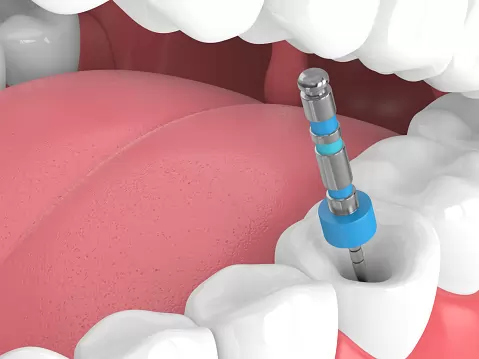
Intracanal fiber post placement is a precise adhesive (bonding) procedure carried out following root canal treatment, under fully sterile clinical conditions, along with millimetric depth measurements. First, the upper two-thirds of the fresh filling material (gutta-percha) inside the root canal is melted away and emptied using special heated tips or medical drills (Peeso reamers), without disturbing the seal at the root tip. This opened post space is smoothed by scanning it with specially calibrated drills matched to the micron thickness of the chosen fiber rod. After the canal is chemically prepared with acid and bonding agents, dual-cure (both light- and self-curing) composite cements are injected into the fiber post space, and light-curing completes the monoblock bond.
- Canal Length Calibration: Using X-ray cross-sections to set the post’s depth so it does not exceed two-thirds of the root’s length.
- Apical Seal Protection: Leaving at least 4–5 mm of untouched canal filling at the base, to prevent infection leakage from starting at the root tip.
- Adhesive Cementation: The phase in which the fiber rod is silanized (to increase bonding strength) and placed into the root tunnel with resin adhesive.
- Core Construction: Wrapping composite filling around the fiber tip that extends beyond the canal, preparing the tooth’s crown form (stump structure) for computer-aided design.
How Does Intracanal Fiber Post Placement Support Tooth Durability?
The supportive power of fiber post systems on tooth durability is based on the principles of “homogeneous stress distribution” and “biomechanical integrity.” Conventional large fillings push the loads that come during chewing toward the tooth’s weakened side walls, creating a wedge effect and causing the walls to crack. A fiber post, on the other hand, draws a straight line outward from the exact center of the root canal; from the moment chewing force hits the tooth, the post absorbs this energy and distributes it in equal wavelengths to the bone trabeculae throughout the root. This mechanism brings the tooth’s flexing limits back to the level of a normal living tooth, radically reducing the fracture rate.
- Elimination of the Wedge Effect: Absorbing the forces that would otherwise push the tooth’s walls outward and burst them.
- Restoration of Dentin Strength: Increasing the rigidity of the hollowed-out root tunnel by filling it with a glass-fiber composite mass.
How Does Intracanal Fiber Post Placement Contribute to Aesthetic Restorations?
Especially in front-region smile design practices, the optical quality of the underlying substructure elements directly determines the final aesthetic success, and the fiber post makes a tremendous contribution to this clarity. Old-style metal posts completely block light, so even the most luxurious full-ceramic (E-max or zirconium) crowns placed on top of them reflect a dull, grayish, artificial shadow underneath; they also create a purplish ring of color at the gumline. Glass fiber posts, thanks to their white, semi-translucent structure, refract light like natural tooth enamel and let it penetrate the deeper layers; this guarantees that the tooth looks completely clear, vibrant, and smooth under every angle of light.
- Natural Light Transmission: Eliminating artificial shadows so a sense of natural tooth tissue emerges under the porcelain crown.
- Brightness at the Gumline: Eliminating the risk of metal ions seeping into the mucosa and causing chronic darkening at the edges of the gums.
What Assessments Are Performed Before Intracanal Fiber Post Placement?
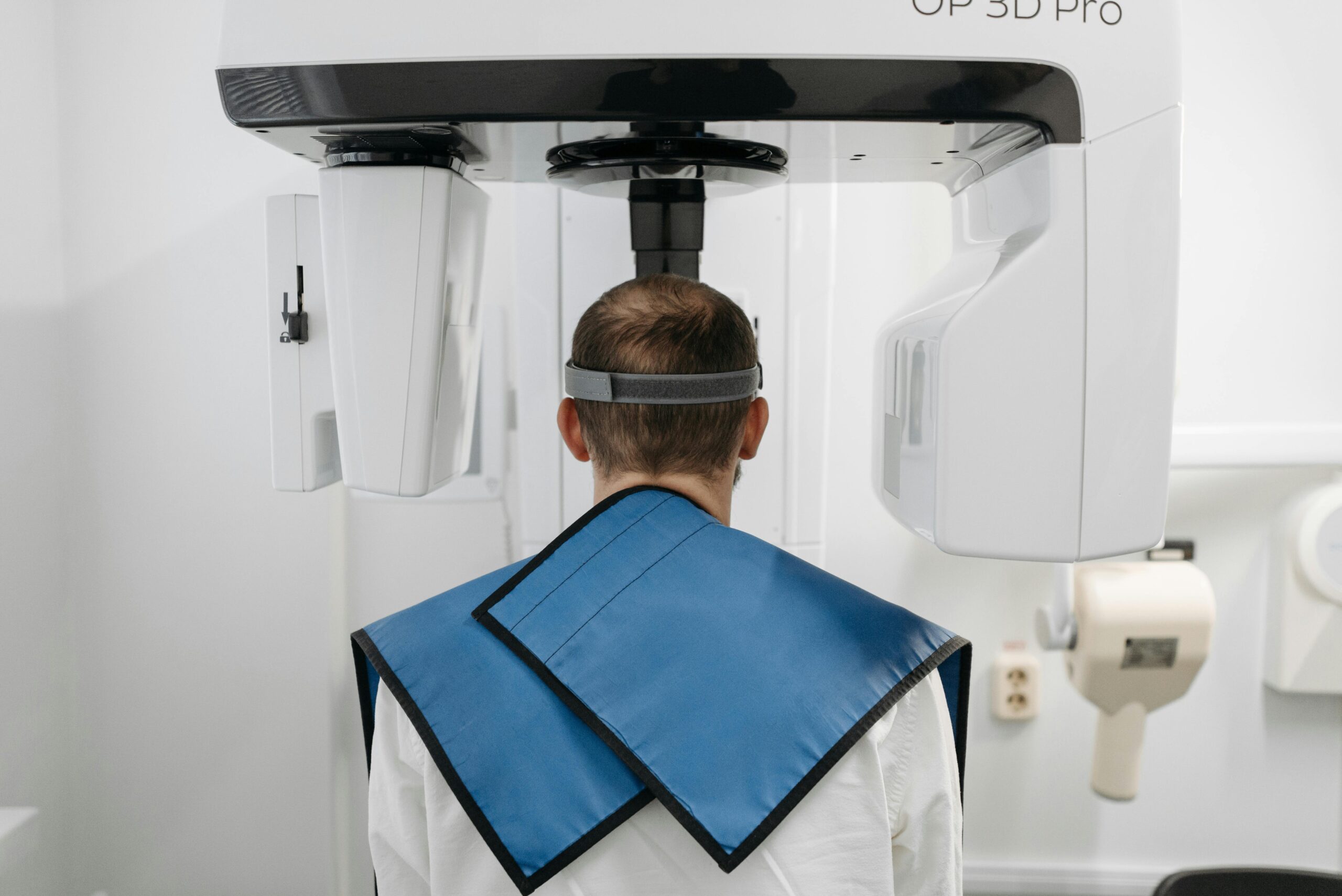
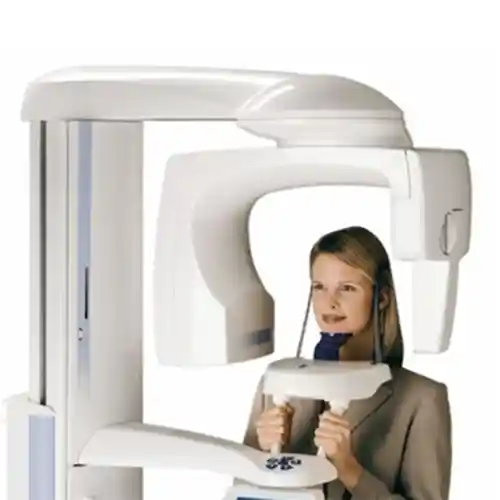
The clinical assessment performed before moving to the application stage is the most critical analysis phase, setting the safety boundaries of the treatment and screening the root’s surrounding structure. The dentist first requests digital panoramic X-rays or high-resolution periapical cross-sections to check the quality of the existing root canal treatment. If an unresolved, hidden abscess (lesion) at the root tip or gaps in the canal filling are detected, the old canal filling must be removed and “root canal retreatment” processes completed before the fiber post is placed — since re-entering the canal after the post is placed is quite difficult.
- Root Wall Thickness Measurement: Determining that the root’s anatomical structure is thick enough not to be perforated while the post space is being opened.
- Confirmation of Periapical Integrity: Radiologically confirming that the bone cells at the root tip are completely free of infection.
- Ferrule Effect Analysis: Measuring the height of healthy wall remaining above the gumline (at least 1.5–2 mm) to calculate the mechanical retention coefficient.
How Long Does Intracanal Fiber Post Placement Take?
The intracanal fiber post procedure is an extremely fast and dynamic session step that fits perfectly with the time constraints of modern metropolitan life, without tiring the patient in the clinical workflow. The stage of preparing the active post space, rinsing it with chemical agents, and light-curing the fiber rod into place is generally completed comfortably in as little as 15 to 20 minutes, depending on the dentist’s technical application speed. The total time, including preliminary preparation and construction of the upper filling, covers a single session of no more than 45 minutes.
- Space Preparation Phase: An average of 5–7 minutes (melting away the canal filling and scanning it with a calibrated drill).
- Chemical Cementation Phase: About 10 minutes (applying acid and bond, infusing the resin cement, and curing it with light).
- Time Efficiency: The convenience of being able to apply it immediately, back to back, within the same session in which the root canal treatment is finished, without wasting time.
Can Intracanal Fiber Post Placement Be Completed in a Single Session?
Yes, intracanal fiber post placement can be comfortably completed in a single sitting, as long as the tooth does not have a chronic, complicated abscess discharge at the root tip and the root canal treatment has been smoothly finished within that same session. In fact, thanks to today’s digital dentistry (CAD/CAM) infrastructure, the tooth can be scanned in the same chair session, the fiber post cemented in place, and immediately afterward the upper zirconium crown milled by robotic devices and permanently delivered to the patient within a few hours; this integrated workflow maximizes clinical time efficiency.
- Same-Day Restoration: The luxury of completing the impression, design, and fiber reinforcement stages all within a single appointment block.
- Tissue Stabilization: Eliminating the need to leave the canal open with temporary fillings for days, reducing the risk of leakage infection to zero.
What Should Be Watched For After Intracanal Fiber Post Placement?
There are certain basic home-care rules the patient should follow after the procedure to make the success of the fiber injection session permanent and to preserve the balance of full curing (polymerization) of the injected composite bonds beneath the tissue. Since the tooth’s nerve networks were already removed during the root canal treatment, the tooth does not feel pain; however, since the surrounding jawbone attachments will be in a phase of mechanical stimulation, taking protective measures in the first few days is essential.
The points that must be carefully followed during the critical period after the procedure are as follows:
- No food should be eaten during the first 2 hours until the effect of the local anesthesia (numbness) has fully worn off, to prevent injury to the tongue and lips.
- If a follow-up appointment has been scheduled for a permanent porcelain crown to be placed on top of the fiber post, hard nuts and shelled foods should not be chewed on that side while the tooth is still in its temporary stage.
- It is normal for mild micro-tension aching to occur at the injection points on the day of the procedure; this can be comfortably relieved with anti-inflammatory pain relievers.
- Oral hygiene routines (brushing and flossing) should continue uncompromisingly with gentle movements that don’t disturb the treated area, starting from the evening of the procedure.
What Is the Healing Process Like After Intracanal Fiber Post Placement?
Since this is a minimally invasive injection process in which neither the skin nor the gums are cut with a scalpel, the tissue recovery phase after the procedure progresses extremely quickly, predictably, and comfortably; however, because the root canal is scanned and widened with mechanical drills, it is normal for the surrounding periodontal ligaments to show a mild repair response to this. During the first 3–5 days, it is a natural part of healing to feel mild sensitivity or tenderness to touch, especially when the teeth suddenly hit each other or hard chewing occurs; this decreases and fully resolves on its own within a few days.
- First 48 Hours: The phase in which the sensation of internal tissue tension is most noticeable (these aches are easily blocked with pain relievers).
- The 1-Week Mark: The acute adaptation process is completed, and the resin cement fully integrates with the extracellular matrix, reaching its final hardness.
Which Restorations Can Intracanal Fiber Post Placement Be Used Together With?
Intracanal fiber post technology can be planned in smooth combination with many different restoration components of medical aesthetic dentistry, in order to increase the retention and fracture resistance of the upper structure elements. After the post restores the lost body volume to the tooth, the aesthetic architecture of the upper layer is decided by the specialist dentist. The combination chosen depends on the amount of visible wall remaining in the tooth.
- Zirconium / E-Max Crowns: Full-ceramic aesthetic crowns built onto the fiber post framework when the crown portion of the tooth is entirely missing.
- Porcelain Inlay / Onlay Fillings (CAD-CAM): If the tooth’s side walls are partially preserved, milling only the missing piece from porcelain and cementing it onto the post.
- Aesthetic Composite Core Fillings: In borderline cases where tissue loss is relatively minor, finishing by filling around the fiber rod with light-cured aesthetic fillings.
What Factors Affect the Long-Term Success of Intracanal Fiber Post Placement?
Whether fiber post restorations can remain in the mouth for many years without falling out or breaking depends directly on a series of technical and medical criteria being carried out flawlessly at the time of the session. The single most uncompromising factor for long-term success is moisture control; because resin adhesives are extremely sensitive to wetness, if even microscopic saliva or breath moisture seeps into the canal during the procedure, the bonding strength collapses by around 80%, eventually resulting in the post coming loose.
- Use of a Rubber Dam: Ensuring the absolute isolation of the working area from oral fluids using a rubber sheet.
- Quality of Intracanal Cleaning: Fully scraping away and cleaning out the old sealing oils and paste residue on the walls of the root tunnel.
- The Dentist’s Adhesive Craftsmanship Experience: Millimetric adherence to the chemical timing protocols for acid, bond, and dual-cure cement.
How Does Intracanal Fiber Post Placement Contribute to Preserving Natural Tooth Structure?
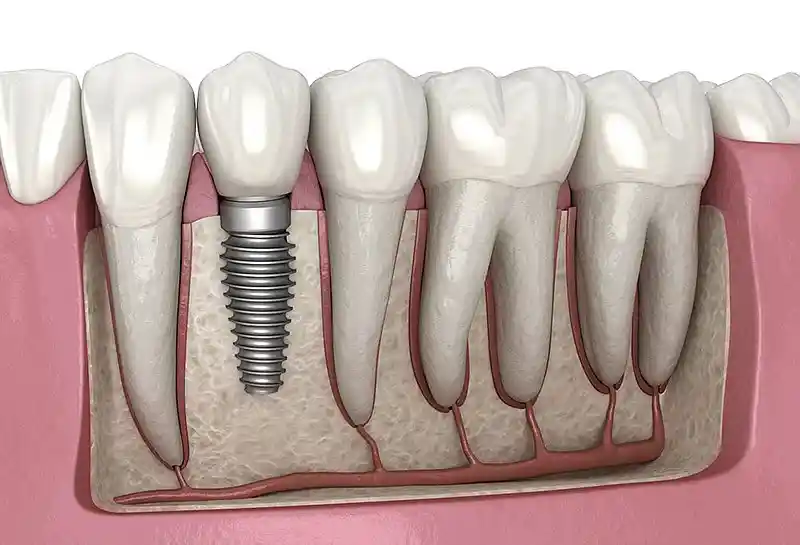
The most revolutionary contribution this advanced-technology intracanal approach makes to tissue-preservation biology is protecting the tooth’s “organic root presence” instead of condemning it to surgical extraction. No matter how advanced they become, artificial titanium implants are fused to the jawbone like a screw and can never possess the natural nerve receptors that sense chewing pressure the way a person’s own tooth does. By filling only the destroyed inner chamber of the tooth while preserving the outer root integrity exactly as it was, the fiber post offers an invaluable contribution to the patient sustaining natural, comfortable chewing reflexes with their own tooth for a lifetime.
- Receptor Preservation: The permanence of the ability to sense the hardness of food, thanks to the preservation of the living fibers around the tooth root.
- Preservation of Bone Volume: As long as the root remains in the mouth, erosion (atrophy) of the surrounding alveolar jawbone is prevented, and bone architecture is preserved.
Frequently Asked Questions About Intracanal Fiber Post Placement
Below are the most common practical concerns on the minds of patients recommended to undergo intracanal fiber post placement in order to save teeth with extensive tissue loss, along with their clear, straightforward medical answers:
Does the fiber post procedure hurt during the session — does working inside the root canal cause aching?
No, you absolutely will not feel the slightest pain or ache. Because the tooth being treated has already had root canal treatment beforehand, all the nerve networks inside it have been completely removed; as a result, that tooth no longer has any biological mechanism left that could produce a pain or ache signal. Throughout the session, all you will perceive, in a numbed state, is the gentle vibration of the drill and the coolness of the water.
Could this fiber rod placed inside the canal come loose or fall out later on?
If absolute moisture isolation (a rubber dam) was ensured during the procedure and the correct pharmaceutical adhesive agents were used meticulously, the risk of the fiber post coming loose or falling out is close to zero, because it chemically fuses to the tissue much like a dye molecule would. Even in cases of extreme mechanical strain (such as an accident) where a filling might come off, the post generally remains fixed inside the root; the situation is monitored safely through annual check-ups.
Is it medically problematic to have an MRI scan while I have a fiber post in my mouth?
No, there is absolutely no problem or medical contraindication whatsoever. Old-style metal screws (posts) contain magnetic material and could cause flare artifacts or create risks in MRI machines. Fiber posts, however, are made entirely of glass fiber and organic polymers, giving them an “amagnetic” nature (unaffected by magnetic fields); as a result, they cause no harm to the body during tomography or MRI scans and produce no flare artifacts.
After a fiber post is placed, is it absolutely necessary to also get a crown on the tooth?
If the tooth’s remaining outer crown walls have been completely lost, placing a zirconium or porcelain crown on top of the tooth is a medical necessity for long-term success, in order to evenly transmit chewing load to the surrounding ligaments and to keep the filling’s edges sealed. However, if the tooth’s side walls have been partially preserved, the dentist can also safely finish the treatment without a crown, simply by filling around the post with aesthetic fillings.
Can I go back to my normal life and work right away on the day the fiber post procedure is done?
Yes, intracanal fiber post placement is a completely local, non-invasive piece of restorative work that does not affect consciousness or motor skills and involves no stitches or incisions; therefore, the very second the session ends, the patient can get up from the chair and continue their normal daily, professional, social, or academic life rhythm right where they left off. There is no clinical obstacle to driving immediately after the procedure.
Who We Are? & Panorama Ankara Oral and Dental Health
Panorama Ankara is a licensed oral and dental health center that brings together an academic team of specialists and the latest global bio-technological digital infrastructure under one roof — not only in oral, dental, and maxillofacial surgery, implantology, orthodontics, and cosmetic dentistry, but also in microscopic endodontics and prosthetic dentistry — providing patients with institutional health assurance. Rather than surrendering teeth destroyed by deep decay or accidental fractures to the convenience of surgical extraction, our center places vital importance on preserving natural root integrity in the mouth through evidence-based medical disciplines, and uncompromisingly operates original Intracanal Fiber Post Placement ecosystems in its clinical restorative workflow that provide high mechanical resistance and flawless aesthetics.
Across all radiological, screening, design, and microscopic restorative interventions carried out at Panorama Ankara, the principles of absolute sterilization, high patient safety, transparency, and honesty are enforced without compromise, in accordance with our founding charter. In our clinical practice, absolute rubber-dam moisture isolation systems that keep resin bonding strength at its maximum, and CBCT 3D tomography planning units that capture micron-level cross-sections, are applied with millimetric precision under the supervision of our team of expert endodontists and prosthodontists. Our aim is not to impose on our patients those old, harsh, screw-type metal post molds that eventually split the root in two — but to analyze each tooth’s root canal flexibility balance on a digital screen, providing maximum session comfort without harming surrounding soft tissue or blood vessels, a same-day dentistry standard, and watertight sealing quality that lets you smile with your own original tooth root for a lifetime. If you’re tired of your deep fractures yet worried about the risks of tooth extraction or implants, and you want to begin your smart, preventive treatment process from start to finish with scientific assurance at an expert center, you can get in touch with the expert team at Panorama Ankara and protect your health and the integrity of your smile through a detailed examination and the comfort of our fiber post treatment.