

What are Inlay and Onlay Dental Restorations? How are they different from fillings?
In oral and dental health processes, the methods used to repair losses in tooth structure have diversified with the development of technology. In cases where a large part of the tooth tissue is lost but a full crown is not required, “Inlay” and “Onlay” restorations come into play. These methods aim to maximize the durability of the tooth while preserving its natural form. Considered the “golden mean” between traditional filling methods and crown applications, these techniques are an indispensable part of modern aesthetic dentistry.
What are Inlay and Onlay Restorations?
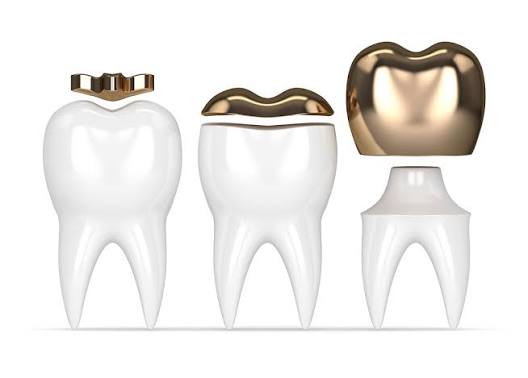
Inlay and onlay applications are actually “partial” restorations prepared in a laboratory environment and placed in the tooth as a whole. While traditional fillings are shaped directly by the dentist in the mouth, inlays and onlays are specially designed according to the impression taken from the tooth. This allows the restoration to adapt much more precisely to the anatomical structure of the tooth, the chewing surfaces, and the contact points with adjacent teeth.
Inlay: These are restorations applied only to the inner region of the tooth, between the ridges (tubercles) on the chewing surface.
Onlay: This is a type of restoration preferred for larger tissue losses, encompassing one or more ridges on the chewing surface of the tooth.
Key Differences Between Inlays/Onlays and Traditional Fillings
Traditional fillings (composite or amalgam) are generally applied directly to small to medium-sized cavities. However, as the loss of material increases, the shrinkage and structural weakness of the filling material can increase the risk of tooth fracture. Inlays and onlays offer structural support at this point. Porcelain or reinforced composites are generally preferred as materials; this meets aesthetic expectations at the highest level.
Inlay and onlay restorations better mimic the natural structure of the tooth. Prepared in a laboratory environment under high temperature and pressure, these materials are much more resistant to chewing forces in the mouth compared to traditional fillings. They also offer superior color stability; they are more resistant to discoloration caused by tea, coffee, or smoking over time.
Why Choose Inlay or Onlay?
- Tissue-Friendly Approach: While a full crown requires cutting the entire circumference of the tooth, inlays and onlays only require cleaning of the damaged area. Healthy tooth tissue is preserved.
- Perfect Fit: Because they are prepared using digital or traditional impression methods, the contact with adjacent teeth is perfect enough to prevent food accumulation.
- Aesthetics and Function: Porcelain materials fully reflect the natural light transmittance and color of the tooth.
- Long Life: With proper oral care, these restorations can be used without problems for decades.
Technical Comparison Table
| Features | Traditional Fillings | Inlay and Onlay Restoration |
|---|---|---|
| Application Time | Single session (Immediately) (in the mouth) | Usually two sessions (including laboratory phase) |
| Material Strength | Medium grade (May wear out over time) | High grade (Resistant to wear and breakage) |
| Sensitivity | Risk of leakage due to shrinkage | Leakage is minimal with special adhesives and a perfect fit |
| Aesthetic Appearance | Good (For composite fillings) | Excellent (Porcelain structure closest to natural tooth enamel) |
| Tooth Tissue Preservation | Maximum preservation | Maximum preservation (Advantageous compared to veneers) |
How Does the Restoration Process Work?
The inlay and onlay restoration process requires meticulous preparation. In the first stage, the decay or old filling in the tooth is cleaned and the tooth is brought to a suitable form. Then, a copy of the tooth is taken using precise impression methods (digital scanners or traditional methods). While this impression is sent to the laboratory, a temporary filling is placed in the tooth.
The porcelain piece, designed in the laboratory according to the anatomical structure of the tooth, is tried on by the dentist in the second session. If everything is in order, the restoration is fixed to the tooth using special bonding systems. This chemical bonding ensures that the restoration becomes one with the tooth, increasing the tooth’s resistance.
Conclusion: Which One Is Right for You?
If you have significant tooth structure loss but most of your tooth is still healthy, inlay or onlay restorations are the ideal solution. Your dentist will determine the best option based on radiographic examinations and an intraoral examination.This will determine which method will extend the life of your tooth. It should be remembered that the best restoration is the one that preserves the natural tooth tissue the most.