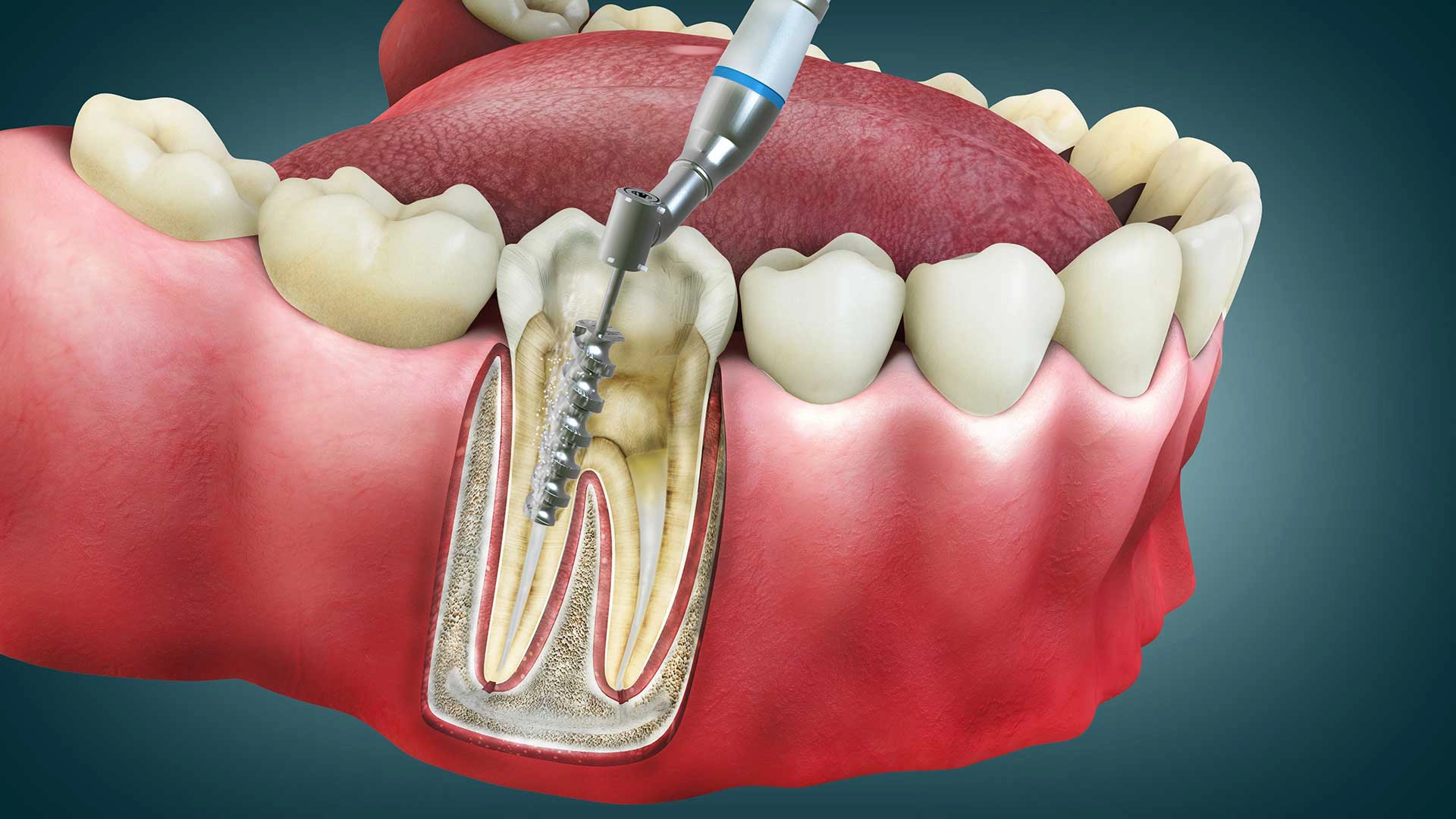


Whether a wisdom tooth (the “20s tooth”) can be filled depends on its position: if the tooth has erupted enough, the decay is limited and the area can be cleaned with a toothbrush, a filling can be placed. If the tooth is partly impacted, the decay has reached the nerve or the area cannot be kept clean, a root canal treatment, a crown or an extraction is considered. The right option is determined by the position of the tooth and its X-ray image.
Filling, root canal, crown and extraction at a glance
The four options answer different questions on the same tooth: a filling removes the decay and fills the gap, a root canal treatment cleans the nerve tissue inside the tooth, a crown protects a weakened tooth from the outside, and an extraction is the removal of the tooth from the mouth. The table below puts the points that decide the choice side by side.
| Option | How it is done | Who it suits | Duration | Care afterwards |
|---|---|---|---|---|
| Filling | The decay is removed and the gap is filled with a tooth-colored material. | A tooth with superficial decay that has erupted enough and can be reached by the toothbrush. | Mostly a single appointment. | Keeping the filling edge clean, regular check-ups. |
| Root canal treatment | The infected nerve tissue is removed, and the canals are cleaned and filled. | A tooth whose decay has reached the nerve and whose roots are accessible. | One or a few appointments. | It often needs to be protected with a crown or a strong filling. |
| Crown | The outside of the tooth is covered with a crown prepared to measure. | A tooth that is largely broken down but has a sound root and carries chewing load. | Several appointments for the impression and cementing. | Cleaning of the margin, precautions if you clench your teeth. |
| Extraction | The tooth is removed; an impacted tooth may need a small surgical procedure. | A tooth that is too broken down to be kept, keeps getting inflamed or harms the neighboring tooth. | Short for a simple extraction, longer for a surgical one. | Care during the healing period and a check-up. |
When a wisdom tooth can be filled
A filling can be placed if the chewing surface of the tooth has come into the mouth and the decay has stayed on the surface. In this case the gum has moved off the top of the tooth, the dentist can clean the decay easily and the filling edge ends in a place that the toothbrush can reach.
A filling will work in these situations:
- The decay is only in the enamel and dentin, away from the nerve.
- The tooth has fully erupted and closes properly against the opposing tooth.
- There is no gum inflammation or pain, and the area around the tooth is easy to clean.
- No damage has occurred on the neighboring tooth.
A composite filling placed in such a tooth preserves tooth tissue and is often completed in a single appointment.
How a filling is done on a hard-to-reach tooth
Because the wisdom tooth sits at the very back of the mouth, the dentist’s view and access with instruments become harder during a filling. This difficulty makes it harder to keep the filling dry and to seal its edges completely; for this reason good light, suitable instruments and the patient’s ability to open the mouth wide enough are needed.
If the gum partly covers the top of the tooth, the filling edge may end up under the gum, and this area cannot be cleaned. In such a case, even if a filling is placed, the decay may return, so the dentist usually also discusses alternatives such as reshaping the gum or extracting the tooth. At Panorama Ankara, tools such as intraoral digital scanning, digital periapical X-rays and computer-assisted digital anesthesia are used to see the condition of the tooth and carry out the procedure with ease.
Can a root canal treatment be done on a decayed wisdom tooth
It can, but it makes sense on teeth whose roots are accessible and whose remaining structure can be preserved. Because the root canals of wisdom teeth are often curved, thin or more numerous, this procedure is harder than on front teeth. The position at the back of the mouth also makes it harder to guide the instrument.
On a tooth with very curved roots or canals that cannot be reached at all, a root canal treatment may not be suitable; in that case extraction is considered. On an accessible tooth, however, a root canal treatment may be a way to keep the tooth in the mouth.
Which option suits whom
A filling suits people who want to keep the tooth as it is and whose decay is limited; a wisdom tooth that can be cleaned is not extracted unnecessarily. A root canal treatment is an option for people who want to keep the tooth in the mouth without pain and whose roots are accessible, but the tooth then needs to be protected afterwards.
A crown is planned for a person whose tooth has had root canal treatment or is largely broken down but has a sound root. An extraction can be an easier path for those who want to end recurrent inflammation, a hard-to-clean tooth and damage to the neighboring tooth. Which one is right for you is decided by looking at age, mouth opening, the eruption status of the tooth and general health together; the approach can therefore differ between young and older people.
When a crown is considered
A crown is considered when most of the tooth is broken down and the root is sound, especially to protect the tooth from fracture after a root canal treatment. Because it is one of the teeth that carries the most chewing load, a filling alone may not be enough on a wisdom tooth that has had a root canal treatment.
However, for a crown to be made, the tooth needs to be in a position where it can be worked on in the mouth and in contact with the opposing tooth. For a wisdom tooth that has not come in at all or has no opposing tooth to close against, a crown is often unnecessary. The dentist decides on the crown material according to the position of the tooth and the chewing load.
When an extraction is decided
An extraction is recommended when keeping the tooth would not be of benefit or when it harms its surroundings. The main reasons that lead to an extraction decision for a wisdom tooth are these:
- Recurrent gum inflammation (pericoronitis) and pain.
- Causing decay or root decay on the neighboring tooth.
- Being impacted or partly impacted and impossible to clean.
- Appearing to be associated with a cyst or a similar formation.
- Being too broken down to be suitable for a root canal treatment and a filling.
An extraction is sometimes the easiest solution, because trying to keep a hard-to-clean tooth can create a constant cycle of decay and inflammation. Extraction of impacted teeth is a surgical procedure; we explain the details on the wisdom tooth extraction page.
Exam, X-ray and CBCT assessment before the decision
The basis of the decision is imaging that shows the position of the tooth in the mouth and its roots. At the exam, first how far the tooth has erupted, the condition of the gum and the location of the decay are examined. Then a digital panoramic X-ray shows the general picture, while a periapical X-ray shows the root of a single tooth and the depth of the decay.
If the tooth is impacted or partly impacted, or if its relationship with the nerve is a concern, 3D dental tomography (CBCT) gives a three-dimensional image of the root and the surrounding tissue. Without this image, making a firm decision between a filling, a root canal treatment or an extraction would not be reliable, especially for complicated teeth.
Check-ups and long-term follow-up after treatment
With every option, regular check-ups after treatment determine how lasting the result is. On a wisdom tooth that has been filled, whether the edge is clean and whether the decay has returned is followed with X-rays. On a tooth that has had a root canal treatment, the dentist looks for pain, swelling or discharge from the gum. After an extraction, the healing of the wound and the condition of the neighboring tooth are checked.
Oral hygiene is especially important for this tooth: using a small-headed brush that can reach the back area, dental floss or an interdental brush slows down decay.
Frequently asked questions
Does a filling on a wisdom tooth hold up in the long term?
How long it lasts depends on how cleanable the filling edge is and on how the tooth closes. A filling on a wisdom tooth that is easy to clean, away from the gum and closing correctly can serve for a long time; on a filling in an area that cannot be cleaned, decay may return.
How many sessions does wisdom tooth treatment take?
A filling is mostly finished in a single appointment. A root canal treatment can be spread over one or a few appointments, and a crown requires several appointments for the impression and cementing. For an extraction, the duration changes depending on whether the tooth is impacted; the dentist gives the exact schedule after the exam.
Wisdom tooth exam in Çankaya
For a wisdom tooth, the sound way is to assess together with imaging whether a filling, a root canal treatment or an extraction is needed. At Panorama Ankara’s clinic in Çankaya, the condition of your tooth can be examined with digital X-rays and CBCT; to go over the options, you can look at the wisdom tooth treatment options page or reach us for an appointment through the Panorama Ankara page.