

Ankara Narrow-Diameter Implants: Elegant and Long-Lasting Aesthetics in Tight Tooth Gaps with Panorama Ankara
Modern dentistry and implantology have not only focused—based on biomechanical data accumulated over the years—on replacing missing teeth, but have also increasingly aimed to produce micro-engineering solutions for the challenging limitations imposed by human anatomy. While standard-size dental implants require a wider diameter and greater volume to withstand chewing forces in the posterior regions of the jaw (the molar area), they may not be physically suitable for narrow spaces encountered in the anterior region of the mouth—especially in the lower incisors or the upper lateral incisors. In patients with congenital tooth absence (agenesis), long-standing gaps that have narrowed because adjacent teeth have tipped toward each other, or anatomically very thin jawbone ridges (narrow crest width), attempting to place a standard-diameter implant into a tight space can cause irreparable damage to the roots of neighboring teeth. By combining advanced surgical and aesthetic principles in Ankara narrow-diameter implant applications, Panorama Ankara offers a fixed, independent, and aesthetic restoration option in these narrow interdental (between-teeth) distances—where millimetric calculations are vital—without harming adjacent tissues or roots.
Narrow-diameter implants, as the name suggests, differ radically from the wider body diameters of conventional implants—typically ranging from 3.5 mm to 5.0 mm—by being produced in ultra-slim diameters, generally between 2.7 mm and 3.3 mm. This slim form factor enables clinicians to maintain the essential “safety margin” (biological space)—at least 1.5 mm—between the implant and the roots of neighboring teeth even in tight areas where only 5–6 millimeters of space exist between two teeth. A standard implant placed too close to adjacent roots can compromise blood supply (vascularization) to the bone in that region, leading to bone loss and even the loss of neighboring teeth. After radiological measurements, Panorama Ankara’s experienced oral surgeons incorporate narrow-diameter implants in all cases where horizontal bone volume and interdental distance would make a standard implant risky—thereby protecting patients from months-long orthodontic treatment (creating space with braces) or from risky advanced bone grafting (ridge widening with bone graft material), and placing the treatment journey on a far more comfortable and predictable path.
Materials Science and Biomechanics: The Strength of Titanium–Zirconium Alloys
As an implant’s diameter decreases, the surface area that contacts bone (the osseointegration area) also decreases, and the mechanical stress on the implant body (fracture risk) increases according to the laws of physics. For this reason, standard pure titanium materials may not provide sufficient resistance in the manufacture of narrow-diameter implants. Revolutionary advances in dental materials science have enabled the use of ultra-high-strength biomaterials—such as titanium–zirconium (TiZr) alloys, which offer very high tensile and fatigue resistance—for the production of these slim implants. By combining zirconium’s fracture resistance with titanium’s ability to integrate with bone, this new generation of narrow-diameter implants can withstand chewing forces far better than a standard-diameter implant made of pure titanium. Panorama Ankara safeguards the long-term physical integrity of the restoration by choosing narrow-diameter implant systems with high-alloy composition and micro-roughened surface technology, whose biomechanical tests have been validated by independent international organizations, particularly for narrow-space restorations in the aesthetic zone.
This high mechanical resistance provided by alloys is a major advantage not only for the implant body itself, but also for the prosthetic components (abutments) and porcelain/zirconia crowns placed on top. When creating an aesthetic tooth in a narrow area, the emergence profile (the way the tooth appears to “emerge” from the gum) must start narrow like a natural tooth and gradually widen. Narrow-diameter implants provide precisely the anatomical foundation needed to create that narrow emergence profile. While making a narrow porcelain tooth over a wide implant can be biomechanically impractical, a zirconia crown positioned over a slim implant can form an optical and physical replica of a natural incisor with excellent lip and gingival harmony.
Clinical Classification: An Analysis of Narrow-Diameter vs. Standard Implants
Selecting the right material according to a patient’s oral anatomy and the location of missing teeth is the cornerstone of surgical success. While narrow-diameter implants (NDI) can play a life-saving role where standard implants cannot fit or would be prone to failure, they are generally not the first choice for posterior molar regions where chewing loads are extremely high. Panorama Ankara is committed to communicating the biomechanical limits and clinical rationale of the proposed treatment with full transparency. The table below summarizes the anatomical use areas and operational differences between narrow-diameter implants and conventional standard implants.
| Clinical and Biomechanical Criteria | Narrow-Diameter Implants (NDI) | Standard-Diameter Dental Implants |
|---|---|---|
| Average Body Diameter | Typically ranges between 2.7 mm and 3.3 mm. | Typically 3.5 mm to 5.0 mm or larger. |
| Clinical Indications (Use Area) | Upper lateral incisor and lower anterior incisor tooth loss; narrow interdental spaces. | Upper central incisors, premolar, and molar regions. |
| Interdental Space Requirement | Can be safely placed in tight spaces of 5 to 6 millimeters. | Requires a wider space of at least 7 to 8 millimeters. |
| Need for Bone Grafting | Greatly reduces the need for bone grafting in cases with thin ridges. | In thin bone, often requires ridge widening surgery (grafting) before implant placement. |
Anterior Aesthetics: Preserving Gingival Papillae and the “Black Triangle” Risk
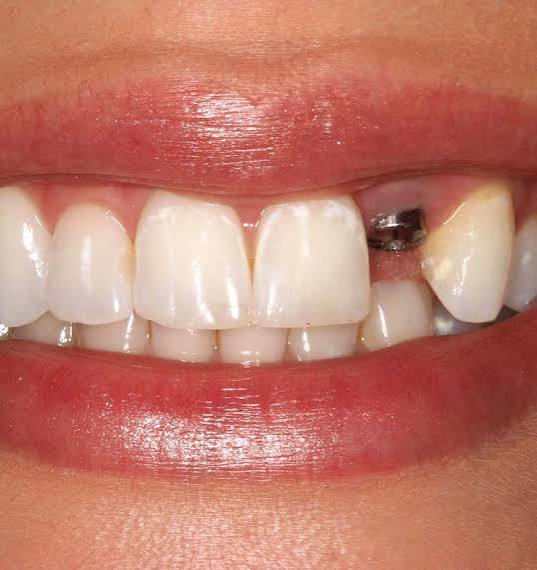
The anterior region of the mouth (the smile line) is the clinical area in dentistry where aesthetic tolerance is the lowest and patient expectations are the highest. In this region, the fate of aesthetics is determined not only by the “white” part of the tooth, but also by the gum architecture around it—especially the triangular pink gingival tissue between two teeth (the papilla). When a front tooth is lost, the surrounding bone begins to resorb quickly, and as the bone resorbs, the papilla tissue supported by that bone collapses as well. Dark gaps that appear between teeth when the gum papilla is missing are called “black triangles” in medical literature. If a standard or wide-diameter implant is forced into a narrow space, it can approach adjacent roots too closely and destroy the thin interproximal bone support between them. Once this bone is lost, the papilla above it is irreversibly lost too, and black spaces remain between the teeth when the patient smiles.
This is the greatest biological aesthetic triumph of Ankara narrow-diameter implant applications in the aesthetic zone. By using a slim implant, Panorama Ankara clinicians ensure that the precious bone tissue (at least 1.5–2 mm) between the implant and neighboring teeth remains intact. Because this bone is preserved, the gingival papilla also maintains its form and does not collapse. When a zirconia-ceramic crown is added, the gum embraces the porcelain in a tight, triangular form—just as it would around a natural tooth. This microscopic tissue management is the most critical aesthetic touch that enables the new implant tooth to appear not as an artificial prosthesis, but as a natural organ emerging from the patient’s own jaw.
Congenital Tooth Absence (Agenesis) and Treatment in Young Adults
One of the most common—and most life-changing—indications for narrow-diameter implants is “lateral agenesis,” a condition in which the upper lateral incisors are congenitally absent. In this genetic anomaly, when the patient reaches adolescence, the primary tooth may fall out, but because there is no developing permanent tooth germ beneath it, that area remains empty. If the space remains for a long time, canines drift forward and a very narrow, irregular gap is left in the middle. Typically, these patients undergo orthodontic treatment during adolescence to align teeth properly and open a space for a lateral incisor; however, the space created is not always wide enough to accommodate a standard implant.
In young adult patients around 18–20 years old—when jaw and facial growth is complete—cutting down adjacent healthy teeth to create a porcelain bridge is highly destructive and undesirable. In such congenital missing-tooth cases, Panorama Ankara uses narrow-diameter implants to place a delicate titanium–zirconium root into the tight space—without touching the adjacent healthy teeth (the canine and central incisor). As a result, young patients gain a fixed and aesthetic tooth that stands independently for the rest of their lives, without being dependent on neighboring teeth. The primary target groups in which narrow-diameter implant systems are most successful—and which Panorama Ankara treats with detailed planning—include:
- Patients missing upper lateral incisors congenitally or who lost them early due to trauma,
- Individuals who have lost one of the four lower incisors and naturally have some of the narrowest interdental spaces,
- Specific cases where orthodontic treatment has been performed but spaces could only be opened to a millimetric degree (5–6 mm), making standard surgery risky for adjacent roots,
- Patients with very thin horizontal ridge width who want implant treatment with minimally invasive, sutureless methods—without undergoing major bone graft surgery.
Millimetric Planning and 3D Surgical Navigation at Panorama Ankara
Due to the limited working space, placing narrow-diameter implants is among the surgical procedures in dentistry with the highest sensitivity to error (the lowest tolerance). When placing a 3 mm implant into a space of only 5 mm, even a small angulation deviation of 0.5 mm to the right or left can perforate the root of a neighboring tooth. To reduce this major risk to zero, Panorama Ankara has completely abandoned traditional freehand approaches in advanced surgical cases and transitioned to “Digital 3D Surgical Navigation” and “Surgical Guide” systems.
Before surgery, using 3D volumetric tomography (CBCT) data, the root angulations of adjacent teeth are mapped with millimetric precision. In a digital environment, the implant is virtually positioned exactly between the two roots at the perfect angle—maximizing support from surrounding bone while never contacting the roots. Custom guide plates produced with 3D printers based on this virtual plan are seated on the patient’s teeth on the day of surgery. The clinician then places the implant only at the fixed angle and depth permitted by the guide. This digital workflow—leaving no room for hand tremor or visual misjudgment—ensures flawless biological integration and high surgical safety in narrow spaces within the aesthetic zone.
The Safest Path to Elegant, Strong, and Natural Smiles
Missing teeth in narrow spaces were once considered an anatomical challenge with limited solutions—often leading to sacrificing healthy teeth for bridges or relying on small removable partial dentures. By expanding the boundaries of materials science with digital surgery in Ankara narrow-diameter implant applications, Panorama Ankara offers a fixed, independent, and reliable alternative in many cases that have been told “An implant won’t fit here” or “Your bone is too thin.” These micro-engineering marvels—produced by the ideal alloying of titanium and zirconium—create major functional and aesthetic transformations in small spaces.
If you are seeking an aesthetic and permanent solution for a gap between your front teeth, and you want a strong restoration that stands on its own without cutting down adjacent healthy teeth, you can schedule a detailed tomographic analysis appointment with Panorama Ankara’s expert oral surgery and aesthetic dentistry team. By examining your anatomical boundaries in a digital environment, we can confidently map out the most suitable and most elegant treatment route together.