
Ankara Jaw Expansion Appliance
In craniofacial development, a narrow upper jaw (maxillary constriction) is not merely a simple aesthetic “lack of space” problem that causes teeth to crowd because they cannot fit into the jawbone. It is also a major skeletal anomaly that dramatically reduces nasal breathing capacity, creates a foundation for night-time snoring and sleep apnea, and biomechanically “locks” the physiological development of the lower jaw like a lid. In ideal jaw anatomy, the upper teeth are expected to cover the lower teeth from all directions, much like the lid of a box. However, when the upper jaw remains skeletally narrow (V-shaped), this lid drops inside the lower jaw; in medical literature, this destructive biomechanical condition is called a “posterior crossbite.” Crossbite transmits chewing forces to the temporomandibular joint (TMJ) asymmetrically and destructively, leading to facial asymmetries and chronic headaches. By integrating advanced orthopedic and orthodontic engineering principles into jaw expansion appliance treatments in Ankara, Panorama Ankara corrects this skeletal constriction not by simply tipping teeth outward, but by expanding the upper jawbone itself at a cellular level to the right and left. This high-technology protocol—known in the literature as “RME” (Rapid Maxillary Expansion)—gently opens the remarkable growth line running through the center of the jawbone, creating a vast space for perfectly aligned teeth while mechanically widening narrowed nasal airways and providing a lifetime of comfortable, open breathing.
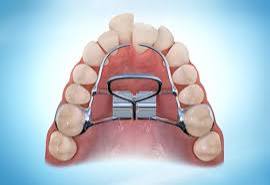
The upper jaw (maxilla) does not develop as a single solid bone during fetal growth; it forms as two separate halves—right and left—that interlock along the midline of the palatal vault like the teeth of a zipper. This cartilage-and-connective-tissue junction, known as the “midpalatal suture” (Sutura Palatina Mediana), is not yet fully ossified (fused) during childhood and early adolescence. The biomechanical philosophy behind maxillary expansion appliances (RPE/RME) relies precisely on high-engineering manipulation of this still-unfused midline. Panorama Ankara’s experienced orthodontic specialists use personalized appliances that are secured to the back molars with medical bands and contain a miniature, high-torque titanium screw positioned in the center of the palate. When the family activates this expansion screw at home each day in the dose prescribed by the doctor (typically about a quarter of a millimeter), the device delivers a horizontal “orthopedic force” to the jawbone through the teeth. This continuous, gentle force painlessly separates the “zipper line” (suture) at the center of the palate to the right and left. Into the newly created gap, the body rapidly delivers new bone-forming cells (osteoblasts) from the bloodstream, filling the area with original, living bone. As a result, the upper jaw grows physically and volumetrically, and the narrow, compressed expression in the midface is replaced by a wider, healthier anatomy operating at full capacity.
Clinical Classification: Pediatric Orthopedics and MARPE (Adult Expansion)
In jaw expansion treatments, the patient’s age and skeletal maturity radically change the type of force applied and the design of the appliance. The midpalatal suture (the “zipper line”) typically ossifies and fuses tightly after about ages 15–18. After this stage, expansion supported only by the teeth may fail to open the bone and instead merely tip the teeth outward, potentially causing the roots to move outside the bone. To transparently define the most appropriate biomechanical pathway according to age range and bone maturation, Panorama Ankara scientifically analyzes and compares the major expansion protocols used in clinical practice in the table below.
| Clinical & Life-Impact Assessment | Conventional Expansion (RME / RPE) – Child & Adolescent | MARPE (Mini-Screw Assisted) & SARPE – Adult |
|---|---|---|
| Skeletal Target & Biomechanical Focus | Orthopedically separates the still-unfused (open) midpalatal suture with tooth-supported force. | To open a fused (ossified) suture, transmits force not to the teeth but directly to palatal bone (cortical anchorage). |
| Appliance Design & Intraoral Attachment | Secured only to the posterior molars (and sometimes premolars) using medical adhesives and metal bands. | The central screw is directly anchored to bone via 2 or 4 micro titanium screws (TADs) placed into the palatal bone. |
| Indication Area & Age Range | Gold standard for ages 7–14, when growth continues and skeletal flexibility is at its maximum. | Applied in late adolescents and adults (typically 16–18+), especially in severe constrictions after skeletal growth is complete. |
| Positive Effect on the Airway | Widening the nasal floor can immediately reduce mouth breathing in children and alleviate tonsil/adenoid-related issues. | Volumetrically enlarges the nasal cavity, dramatically reducing adult snoring and symptoms of obstructive sleep apnea (OSA/OSAS). |
Airway Volume and the Oxygenation Miracle
Anatomically, the upper jaw (maxilla) does not only form the roof of the oral cavity (the palate); it also forms the floor of the nasal cavity. In other words, the palate is the base of the nose. When the upper jaw is narrow and V-shaped, the nasal floor also narrows, airway corridors constrict, and the amount of oxygen a patient can inhale through the nose decreases dramatically. Unable to breathe comfortably through the nose, the patient develops a destructive reflex known as “mouth breathing.” Chronic mouth breathing can cause persistent tonsillar enlargement, contribute to backward positioning of the lower jaw and downward facial growth (Adenoid Face / Long Face Syndrome), and reduce sleep quality—deeply affecting a child’s school performance and concentration.
When a jaw expansion appliance used at Panorama Ankara (RME in children or MARPE in adults) horizontally opens the midpalatal suture, this physical expansion is directly reflected in the nasal floor. As the nasal base widens, the diameter and volume of the nasal airflow corridors (airway volume) mechanically increase. Air turbulence within the nose decreases, and the patient can immediately experience the deep, quiet, uninterrupted nasal breathing they have long missed. Expansion is not only about creating space for teeth; it becomes a vital orthopedic intervention that supports maximum nocturnal oxygenation for the brain and organs—treating snoring and mild-to-moderate obstructive sleep apnea (OSAS) symptoms at a cellular level.
Appliance Activation and Home Maintenance Discipline
Jaw expansion therapy is an ideal team effort in which the remarkable biomechanical design established by the clinician is brought to life by the patient’s (or parent’s) disciplined home routine. For the titanium screw in the center of the appliance to trigger the intended skeletal separation and remodeling, it must be activated (turned) at specific intervals and exactly as prescribed. To ensure pain-free bone formation and protect oral health, Panorama Ankara’s orthodontic specialists recommend that patients/parents follow these two critical rules with uncompromising discipline:
- Using the special activation key provided by the doctor, the turning process—performed in the direction of the arrow on the screw (typically backward toward the throat)—must be done only on the days and at the time intervals prescribed by the doctor (for example, one turn at night before bed). To avoid a sudden, high shock to the bone, missed days must never be “made up” by turning extra times on the same day (over-activation).
- Because the appliance is fixed to the palatal vault, food debris can become trapped around the screw mechanism and beneath the acrylic/metal arms that rest against the palate—areas that cannot be cleaned with a standard toothbrush. To prevent gingival inflammation and bad odor, a high-pressure oral irrigator (“water flosser”) must be used every evening to mechanically rinse under and around the appliance with pressurized water.
Panorama Ankara: Break Narrow Constraints, Build Free Function
The crowded appearance of overlapping teeth or the dark spaces at the corners of the mouth when you smile (buccal corridors) are merely the aesthetic reflections of a skeletal constriction that also steals your breath. By combining orthodontic mechanics with advanced airway physiology and skeletal engineering in Ankara jaw expansion appliance treatments, Panorama Ankara frees you from these narrow constraints and reveals the true anatomical potential of your face. The power of a miniature titanium screw does not only straighten teeth; it also rebuilds a major skeletal foundation that can safeguard your sleep quality, oxygen intake, and TMJ health for a lifetime.
If you notice that your child snores at night or sleeps with an open mouth, or if you are an adult experiencing maxillary constriction and crossbite complaints, you can schedule a detailed jaw orthopedics consultation at Panorama Ankara. With CBCT-supported cephalometric analysis, we can measure your airway volume and design the most appropriate orthopedic expansion pathway (RME, MARPE, or SARPE) with our expert clinicians—so you can experience the privilege of smiling freely and breathing deeply.