

Ankara Porcelain Inlay Application
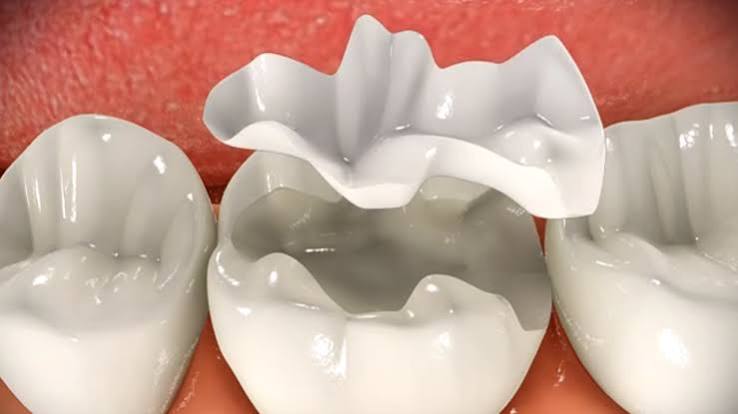
In modern restorative dentistry, the repair of extensive substance loss occurring on the chewing surface of a tooth is no longer limited to standard fillings prepared directly inside the mouth. If the cusps (tubercles) of the tooth remain intact but the central cavity area has expanded beyond the mechanical limits of a composite filling, systems known in medical literature as ‘Porcelain Inlays’ (Indirect Ceramic Restorations) come into play. Redefining the standards of Ankara porcelain inlay applications with a vision of ‘Laboratory Precision’ and ‘Monoblock Integration’, Panorama Ankara offers patients professional ceramic engineering that possesses the natural hardness and light translucency of dental enamel, does not discolor over time, and is highly resistant to wear. The systems applied in our clinic represent a robust clinical tissue-preservation discipline where the restoration is produced outside the mouth with micron precision in digital CAD/CAM units and then locked into the tooth like a puzzle piece.
The true scientific success behind porcelain inlay technology lies in the physical principle referred to in medical literature as the ‘Elimination of Polymerization Shrinkage’, which protects the structural integrity of the tooth. In the advanced conservative dentistry unit of Panorama Ankara, the microscopic shrinkage that occurs in conventional fillings during light curing—creating stress on the tooth walls (C-factor stress)—is eliminated through inlay applications. Since the restoration is fired and hardened at its full dimensions in a laboratory environment, it exhibits no dimensional change when placed on the tooth. These ceramic structures, reinforced with lithium disilicate crystals, adapt to the natural elasticity modulus of the tooth and distribute chewing forces homogeneously toward the tooth root. This vision transforms restorative practices in Ankara from the concept of a “temporary filling” into an advanced ‘Biomimetic Restoration’ center that restores the tooth to its original anatomical form and functional strength.
Clinical Classification: Cavity Geometry and Restorative Material Selection
Whether a tooth should be restored with an inlay or a traditional filling is determined by how much of the intercuspal distance (the distance between cusps) is occupied by the cavity width. This is a critical engineering decision that determines the tooth’s resistance to vertical fractures. In order for patients to clearly understand this advanced tissue-reconstruction process, Panorama Ankara presents the restoration hierarchy applied in the clinic within a scientific framework in the table below.
| Type of Restoration and Scope | Biomechanical Structure and Indication | Panorama Ankara Clinical Application Advantage |
|---|---|---|
| Composite Filling (Direct) | Applied in a single session for small to medium-sized cavities covering less than one-third of the chewing surface. | A fast solution; however, it may carry the risk of marginal leakage and wear over time in large cavities. |
| Porcelain Inlay (Indirect) | The cusps remain intact but the cavity is wide. Laboratory-produced ceramic fills the central space completely. | Its wear resistance is identical to enamel; it physically blocks microscopic marginal leakage (secondary decay). |
| Porcelain Onlay (Partial Coverage) | One or more cusps of the tooth are fractured or weakened; porcelain covers the tooth like a protective shield. | By connecting weakened tooth walls, it prevents the tooth from splitting vertically (fracture). |
| CAD/CAM Hybrid Inlay | Flexible structures produced by digitally milling nanotechnological blocks combining ceramic and composite materials. | Creates a ‘Shock Absorber’ effect that absorbs chewing stress, especially in implant-supported teeth or patients who grind their teeth. |
Marginal Integrity and Adhesive Bonding: Leak-Free Cavity Isolation
The success of a porcelain inlay restoration does not depend solely on attaching the ceramic to the tooth, but on integrating it with the tooth structure through ‘Adhesive Resin’ systems. In the protocols applied at Panorama Ankara, before the laboratory-produced inlay is placed on the tooth, both the tooth surface and the inner surface of the ceramic are roughened at the nanometric level. Special bonding agents used between them chemically lock the ceramic block to the enamel and dentin of the tooth. This robust ‘Monoblock’ structure allows the tooth to flex as a single unit during chewing, preventing the formation of micro-gaps at the restoration margins where bacteria could infiltrate. This represents the most refined engineering discipline that eliminates, at a cellular level, the risk of ‘Secondary Caries’, which often progresses silently beneath conventional fillings—especially in posterior molars.
Biomechanical Adaptation and Maintenance After Porcelain Inlay
Although your porcelain inlays—designed through digital scanning methods and fired with lithium disilicate crystals—are among the most durable restorative structures in the oral environment, maintaining this perfect union with the tooth for a lifetime depends on your personal care discipline. The conservative dentistry board of Panorama Ankara presents the following two fundamental principles to patients as a usage constitution to ensure the long-lasting durability of their inlay restorations:
- To preserve the smoothness of the millimetric margins where the ceramic inlay meets the tooth and to prevent plaque accumulation, in addition to daily brushing, an ‘Interdental Brush’ should be used every night. This ensures that the contact point between the restoration and the neighboring tooth remains biologically clean.
- Although porcelain structures are as hard as natural enamel, they may carry a risk of fracture against excessive localized stress (such as cracking nutshells or biting pens). Therefore, such traumatic habits should be avoided, and regular check-ups every six months should not be neglected to maintain the structural integrity of the restoration.
Protect Your Teeth with Artistic Durability at Panorama Ankara
Fillings that constantly fall out due to extensive decay, sensitivity during chewing, or the fear that your tooth may break at any moment do not necessarily mean that your tooth must be cut down and covered with a full crown. On the contrary, in expert hands, it is a professional process that replaces only the missing part of the tooth through digital design and porcelain engineering. In your search for Ankara porcelain inlay applications, Panorama Ankara combines ‘Marginal Integrity’ and ‘Biomimetic Restoration’ protocols to scientifically free you from weak large fillings, secondary decay, and unnecessary tooth reduction. We respect the remaining healthy structure of your tooth with absolute precision and complete the central cavity left by nature with light-transmitting nanotechnological ceramics crafted with the delicacy of a jewel.
To map the true volume of substance loss in your tooth using our digital scanners, determine the most suitable ‘Lithium Disilicate’ or ‘Hybrid Ceramic’ inlay solution, and achieve a smile that feels as strong as porcelain yet as natural as your own tooth every time you look in the mirror, you can schedule a detailed restorative consultation with the Panorama Ankara clinic and entrust your health to the safe hands of experience and modern dentistry.