
Ankara Onlay Restoration
In modern restorative dentistry, repairing teeth that have lost substance due to deep decay or severe trauma is no longer a process confined to the simple choice between a “filling” or a “crown.” When the damage to the tooth is too extensive for a standard composite filling to withstand, yet not destructive enough to require the entire tooth to be reduced for a full crown, the most advanced micro-architectural solution comes into play—known in medical literature as an “Onlay Restoration” (Partial Crown). Redefining Ankara onlay restoration standards through the vision of “Biomimetic Dentistry” and “Cusp Coverage,” Panorama Ankara offers patients a professional tissue rehabilitation method that restores only the missing chewing cusps using laboratory-fabricated lithium disilicate or reinforced ceramic materials, without touching the healthy side walls of the tooth (the equator line). The systems applied in our clinic represent a reliable clinical engineering approach that extends the biological lifespan of the tooth by placing a “ceramic helmet” over the damaged area—without circumferentially shaving the tooth as done with traditional crowns.
The true scientific success behind onlay ceramic technology lies in the principle known in medical literature as “Occlusal Stress Distribution and Biomechanical Isolation,” which ensures chewing forces are safely transmitted to the tooth root. In the advanced restorative unit of Panorama Ankara, once the decayed tissue of the tooth is removed, the weakened chewing cusps (tubercles) are carefully evaluated. If a standard filling is packed into a weakened cusp, it can create a wedge effect, eventually causing the tooth to fracture vertically over time. In onlay systems, however, these weakened cusps are minimally reshaped, and a ceramic block digitally produced in the laboratory (CAD/CAM) covers the tooth from above like a protective shield. When the immense forces of chewing are applied, this ceramic shield absorbs the pressure, making it physically impossible for the tooth to crack. This vision transforms restorative procedures in Ankara from the irreversible trauma of aggressive “tooth cutting” (preparation) into a minimally invasive discipline that protects the “Remaining Dentin Thickness (RDT)” at the cellular level.
Clinical Classification: Structural Loss Analysis and Restorative Selection Hierarchy
The decision regarding which restorative method should be used to save a tooth is determined by the anatomical limits of the biomechanical destruction it has experienced. The amount of chewing surface lost determines the thin and critical line between choosing an onlay or a full crown. To help patients clearly understand this advanced tissue-preserving strategy, Panorama Ankara presents the restorative hierarchy used in our clinic within the scientific framework below.
| Restoration Type (Clinical Indication) | Biomechanical Scope and Anatomical Limits | Panorama Ankara Clinical Tissue Preservation Advantage |
|---|---|---|
| Direct Composite Filling | Small cavities located only in the center of the tooth that do not involve the side walls or chewing cusps. | Completed in a single chairside session; however, its resistance to chewing pressure is limited in larger cavities. |
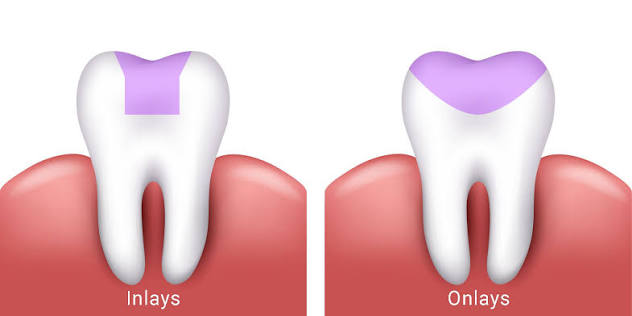
| Inlay Restoration (Ceramic Filling) | Laboratory-made restorations for medium-sized cavities where the filling area is extensive but none of the cusps are destroyed. | Unlike composite fillings, it does not shrink over time (polymerization shrinkage) and biologically blocks marginal leakage. |
| Onlay Restoration (Partial Crown) | Advanced ceramic restorations that support one or more weakened cusps from above without requiring a full crown. | Prevents circumferential tooth reduction and completely protects weakened teeth from vertical fracture by absorbing chewing forces. |
| Full Crown (Zirconia/Porcelain) | Full coverage restorations applied when approximately 70% of the tooth’s cusps and side walls are lost. | Used as a last resort in severely damaged teeth that cannot be preserved with onlays, ensuring structural retention of the root. |
Adhesive Cementation: The Process of Becoming One with the Tooth
The long-term success of an onlay ceramic produced digitally in the laboratory with micron-level precision depends not on simply “gluing” it to the tooth, but on a process of “fusion.” This stage, known in medical literature as “Adhesive Resin Cementation,” integrates the ceramic and tooth enamel at a cellular level. The onlay cementation protocols applied at Panorama Ankara never allow moisture or saliva (bacteria) to weaken this micro-mechanical bond. The unwavering success of this process—considered the heart of biomimetic dentistry—is secured through two uncompromising medical principles implemented in our clinic:
- To prevent saliva and respiratory moisture from microscopically weakening the cementation (bonding) process, a special isolation barrier called a “Rubber Dam” is placed around the tooth during the procedure, creating a completely dry “Zero Moisture” ecosystem.
- The surfaces of both the ceramic block and the tooth are conditioned through roughening procedures (sandblasting and acid etching) and saturated with special bonding agents (silane and primer), ensuring that the restoration forms a physical “Monoblock” (single unit) with the tooth. This eliminates bacterial leakage and secondary decay risks at the cellular level.
Defend the Natural Boundaries of Your Tooth with Panorama Ankara
Teeth that ache during chewing, frequently lose large fillings, or have fractured side walls are not a final stage requiring complete reduction and zirconia crowns. On the contrary, in expert hands, they represent a professional process that can be partially restored using digital dentistry and biomimetic ceramics. In your search for Ankara onlay restoration, Panorama Ankara combines “Cusp Coverage” and “Minimally Invasive Tissue Preservation” protocols to free you from outdated techniques where healthy enamel tissue was irreversibly cut away. We respect the remaining healthy architecture of your tooth 100%, completing the chewing surfaces that nature left incomplete—or time has worn down—with translucent nanotechnological ceramics that fit like a puzzle piece.
To create a millimetric digital map of the structural loss in your tooth using our intraoral scanners (IOS), determine the most suitable “Onlay Ceramic Helmet” solution without requiring a crown, and achieve the aesthetic strength of a restoration that integrates seamlessly with your natural tooth every time you look in the mirror, you can schedule a detailed restorative consultation at Panorama Ankara and entrust your health to the safe hands of experience and modern dentistry.