

What Are the Basic Mechanisms of All-on-4 and All-on-6 Systems?
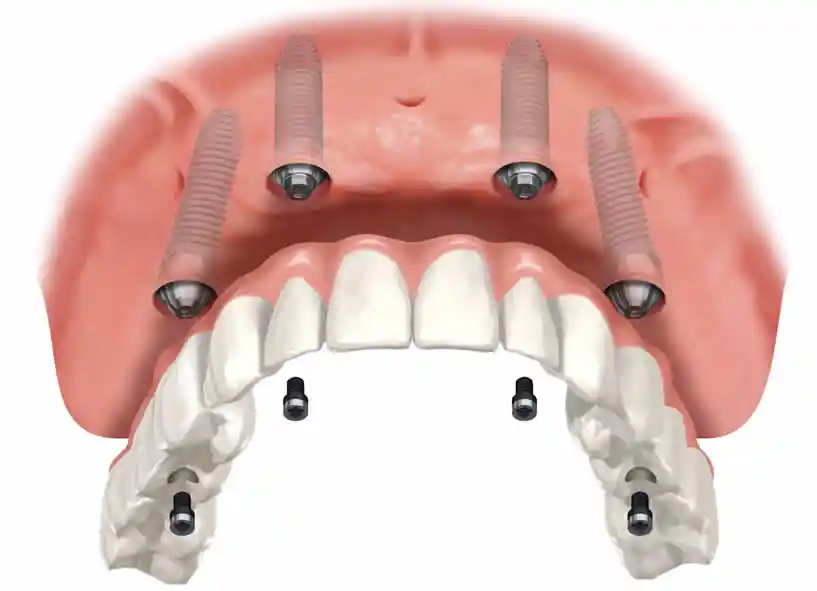
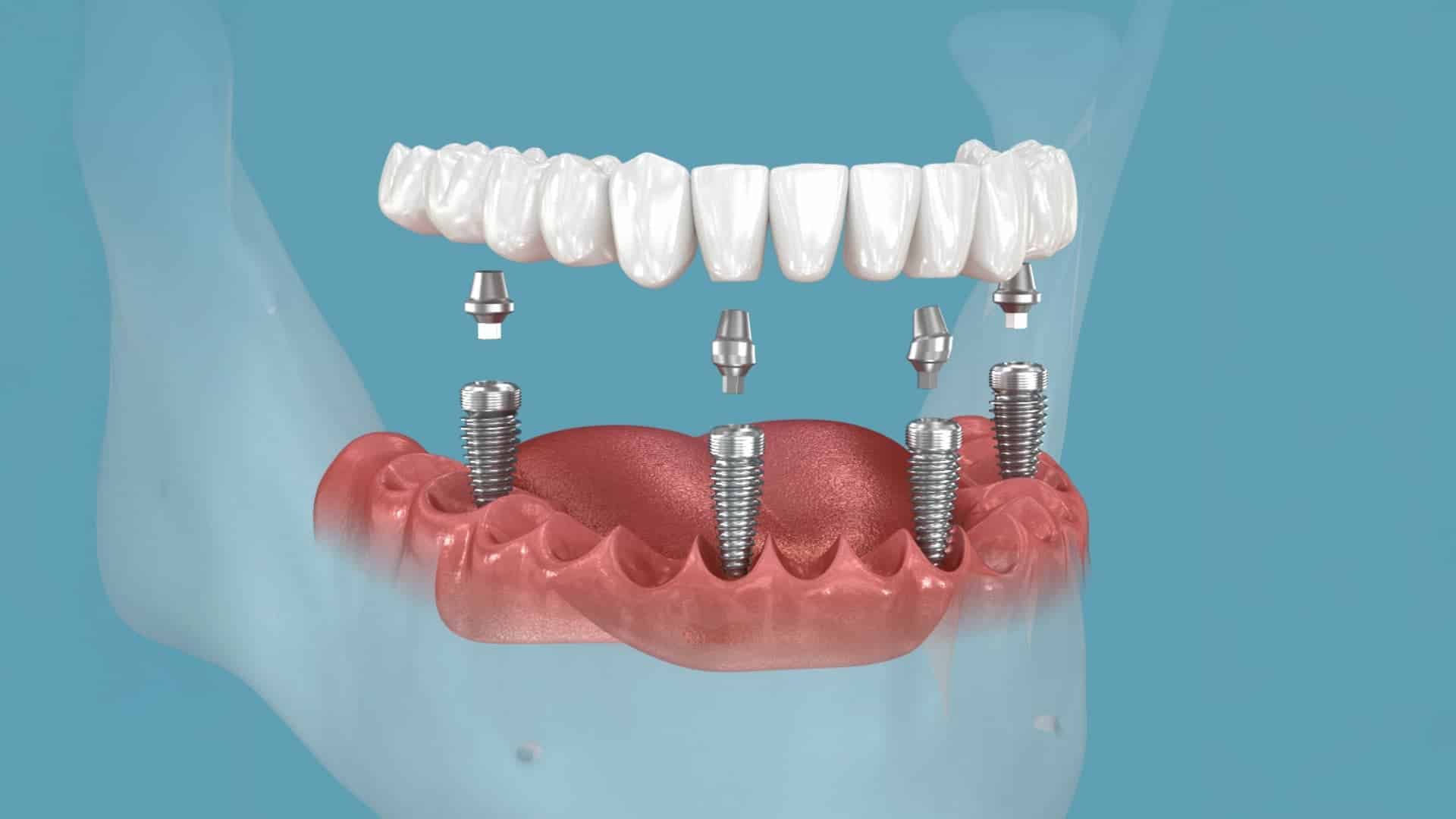
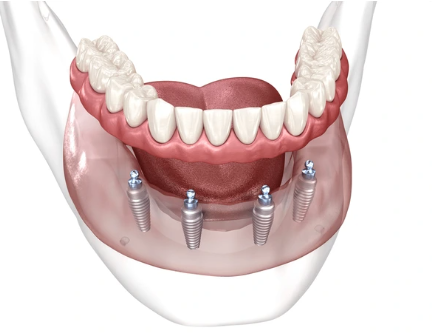
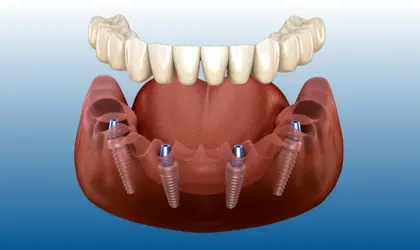
The All-on-4 system involves planning a fixed prosthesis on four titanium roots placed vertically in the front region of the jawbone and at an angle in the posterior regions in order to avoid anatomical cavities. The All-on-6 system, on the other hand, is a treatment protocol that operates on similar principles but distributes the prosthetic load over six titanium roots in cases where the available bone volume is also sufficient in the posterior regions.
These two methods, applied to restore a fixed dental form in individuals with complete tooth loss, differ from one another in terms of the number of biomechanical support points. The number of titanium screws changes how forces are distributed to the jawbone. In the four-implant system, the posterior structures are positioned at an angle of 30 to 45 degrees to draw support from the dense bone in the front region. In the six-implant system, there are two additional support points extending toward the posterior parts of the jaw, and these screws are generally placed at steeper angles into the bone. Both protocols address different anatomical needs based on the underlying logic of the All-on-Four Implant concept: the “transition from a removable prosthesis to a fixed prosthesis.”
How Does Jawbone Density Affect the Choice of Treatment?
Jawbone density is the primary medical criterion that determines the number of titanium roots to be used. When bone loss (resorption) is at a high level in the posterior regions, the four-implant system is preferred, while in cases where sufficient bone height and thickness are detected in the posterior regions, the six-implant system is included in the plan to increase load distribution.
The time elapsed since tooth loss causes the bone tissue to resorb both horizontally and vertically. Physicians analyze the volume of remaining bone by taking millimeter-precise measurements from three-dimensional radiological images. If there is not sufficient bone volume in the posterior parts of the jaw corresponding to the molar teeth, additional surgical procedures (bone-powder grafting) are needed to place six roots. In such cases, in order to avoid including advanced surgical procedures in the process, creating four angled support points directed toward the solid bone in the front region is considered a medical alternative. In individuals with strong bone structure, on the other hand, the increase in number expands the prosthesis’s support area.
In Which Cases Are Six Titanium Roots Preferred?
Treatment planning involving six titanium roots is preferred in individuals with a wider-than-normal jaw arch, individuals with strong chewing muscles, and cases where additional support is needed due to the spongy structure of the upper jawbone. This allows the prosthesis to function while spread over a wider area.
The anatomical structures of individuals are as distinct as fingerprints. In patients with a wide jaw structure, the tooth arrangement of the prosthesis to be prepared in the laboratory is kept longer (for example, 14 teeth instead of 12) in order to ensure aesthetic and functional integrity. Increasing the number of supports in the substructure is a biomechanical necessity to prevent a long bridge structure from flexing or bending inside the mouth. In addition, if the patient has their own natural teeth in the opposing jaw, the chewing pressure will be much higher, so physicians may find it appropriate to include the six-implant system in the treatment plan in order to balance the force.
How Does Chewing-Force Distribution Differ Between the Two Systems?
In the four-implant system, chewing forces are concentrated in the angled structures located at the corner points and transmitted toward the front parts of the jaw, whereas in the six-implant system, these forces are distributed more evenly to both the front and back regions of the jaw thanks to the two extra support points.
According to the laws of physics, the load placed on a bridge is divided among the number of supporting columns and transmitted to the ground. A similar biomechanical rule applies in dentistry. Since the posterior teeth (the molar region) take on the task of grinding during food consumption, they are the areas exposed to the highest pressure. The extra structures positioned close to the molar region in the six-implant system take on the grinding force directly, contributing to the overall stability of the system. In the four-implant system, on the other hand, the prosthesis design is specifically shaped according to this fact, ensuring that the force remains within the limits the implants can bear.
| Biomechanical Criteria | Four-Implant System | Six-Implant System |
|---|---|---|
| Number of Support Points | 4 units (2 vertical, 2 angled) | 6 units (generally at steeper angles) |
| Force Focal Point | Predominantly the front region of the jaw | Distributed across the front and back regions of the jaw |
| Prosthesis Flex Margin | Minimized through laboratory design | Lower thanks to multiple support points |
| Number of Teeth on the Prosthesis | Generally between 10-12 | Generally between 12-14 |
Why Is Upper Jaw Anatomy Decisive in the Decision-Making Process?
Since the upper jawbone (maxilla) has a more porous and spongy structure compared to the lower jaw (mandible), planning six support points instead of four in the upper jaw in order to increase the attachment surface of the titanium roots is considered a medical strategy by physicians.
In human anatomy, the lower jawbone is a mobile joint and therefore structurally has a much denser (cortical) bone structure. The upper jaw, on the other hand, is fixed to the skull and contains air cavities called the maxillary sinuses inside it. This anatomical difference is an important detail in All-on-Four Implant assessments. Expanding the surface area to balance the force in the softer bone structure of the upper jaw supports the integration process. In clinical approaches under Panorama Ankara standards, it is a commonly encountered planning type for the four-implant system to be found sufficient in the lower jaw, while the same patient’s upper jaw transitions to the six-implant system depending on bone quality.
Is There a Difference Between the Two Methods in Terms of Treatment Duration?
In scenarios where bone graft (powder) application is not needed, the surgical application times and temporary-prosthesis stages of both methods are quite close to each other; however, if additional bone procedures are required in the six-implant system, the transition period to permanent prostheses can be extended by a few months.
On the day of the surgical procedure, the physician’s working time can take an average of 30 to 45 minutes longer in the six-implant system due to the two extra screws that need to be placed. The procedure of fitting temporary prostheses on the same day or the following day works similarly in both systems, provided the case is found suitable. The main time difference lies in the condition of the bone. If raising the sinus floor or adding a graft to the area is required in order to perform the six-implant system, the physician can extend the routine 3-month waiting period for fitting the permanent teeth to up to 6 months for the sake of tissue healing.
Do the Prosthetic Structures Used Vary by System?
Prostheses prepared for four-implant systems generally have a somewhat shorter arch due to anatomical limitations, while the larger number of supports in six-implant systems allows for a wider and longer prosthesis arch to be designed in the laboratory setting.
During the laboratory manufacturing stage, the pressure that the substructure forming the base of the prosthesis (generally a titanium or zirconium bar) will be exposed to is calculated. In a four-support structure, the section of the prosthesis that extends backward from the last support point and remains suspended in the air is called a “cantilever” (wing). Since a cantilever length exceeding a certain number of millimeters can lead to mechanical fractures, the length of the prosthesis is kept limited. In the six-implant system, on the other hand, since supporting columns are also present in the most posterior regions, the cantilever distance remains very short or is eliminated entirely; this structurally allows more chewing teeth to be added.
How Do Anatomical Cavities (Sinus and Nerve) Guide the Planning?
If the mental nerve canal running through the lower jaw and the maxillary sinus cavities located in the upper jaw pose an obstacle for the extra screws that would need to be placed at a steep angle, physicians choose to apply the four-implant concept, which involves angled placement, in order to avoid contact with these anatomical cavities.
Respect for tissues is fundamental in medical practice. The vital anatomical structures inside the jaw are natural barriers that determine the limits of treatment. In a lower jaw structure where the nerve canal is very close to the bone surface in the posterior regions, placing a screw in that area carries the risk of nerve damage. Similarly, if the sinus cavities in the upper jaw sag down too far, there is not enough bone left to anchor to in that area. The medical way to overcome these limitations is to avoid the risky areas in the posterior regions and to design an angled system (four-implant planning) in the front regions, where the bone is more reliable.
Are Advanced Surgical Procedures Needed for the Six-Implant Method?
Since the extra screws are intended to be placed in the posterior parts of the jaw in six-support planning, resorting to advanced surgical procedures such as sinus lifting or grafting (adding bone powder) in cases of bone deficiency in those areas is a frequently encountered situation.
The sockets of extracted teeth thin and shorten over time as they become non-functional. If the physician has decided to perform the six-implant system but has detected only 3-4 millimeters of bone in the patient’s posterior region, this area needs to be reinforced with medical materials. The sinus membrane is pushed upward, and biomaterials are used to fill the resulting space, with new bone cells expected to form in this area. These procedures make the surgical process more complicated, can increase the physiological swelling that occurs after the operation, and extend the treatment schedule. For this reason, patient selection is assessed by considering the balance of benefit versus cost.
- Bone Requirement: The six-implant system requires a greater vertical and horizontal bone volume in the posterior regions.
- Surgical Scope: When advanced surgery is applied, the operation time is extended and tissue manipulation increases.
- Healing Period: Since the integration of the grafted bone is awaited, waiting periods can be extended.
How Is the Individualized Method Determined in Panorama Ankara Processes?
In the planning done at Panorama Ankara, both systems are determined not as a standard template but as a result of specific medical assessments tailored to the patient’s tomography data, chewing pattern, jaw size, and age.
Patients who apply to the clinic are examined in detail not only with a panoramic X-ray but also with three-dimensional dental tomography (CBCT). Physicians divide the jawbone into cross-sections digitally, mapping the course of the nerves and the bone’s trabecular structure (internal density) down to the millimeter. While the six-implant system may be found suitable for one patient’s upper jaw, if the same patient’s lower jaw has a very high bone density, the four-implant system can be planned for the lower jaw. These hybrid approaches aim not only to fill in the individual’s missing teeth but also to create the biomechanical foundation that is most compatible with their biological structure.
Does the Number of Implants Affect Cleaning and Care Routines?
An increase in the number of titanium roots inside the mouth means an increase in the number of gum-prosthesis junction points that need to be cleaned; therefore, patients using the six-implant system are expected to spend a bit more time on their daily oral care routine with interdental brushes and an oral irrigator.
In order for fixed prostheses to maintain a healthy form for many years, the areas in contact with the gum need to be kept free of food debris. While there are four columns that need to be brushed and flossed with interdental floss in the four-implant system, this number rises to six in the six-implant system. Cleaning around the sixth screw in particular, placed in the most posterior part of the jaw, requires more manual dexterity from patients. In both systems, the use of pressurized water-spraying devices (waterpik) recommended by the clinic makes the cleaning procedure easier, contributing to supporting gum health.