

Can an Implant Be Placed for a Missing Tooth?
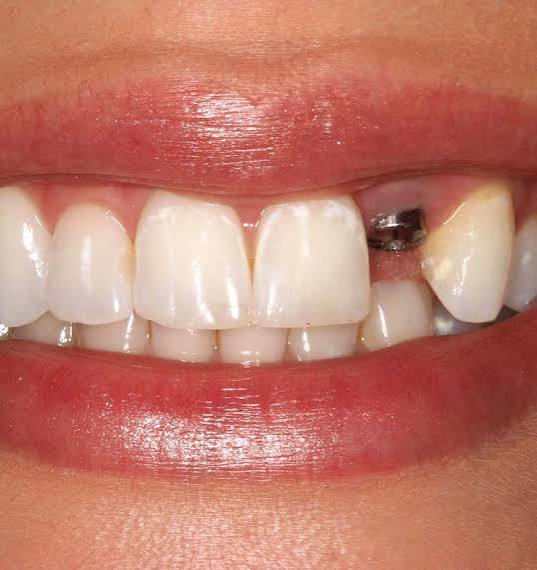
Tooth loss occurring in oral and dental health may require different treatment approaches from both a functional and an aesthetic standpoint. Implant applications are among the methods most frequently evaluated in modern dentistry for replacing missing teeth. However, whether implant treatment is suitable for a given case of missing teeth varies depending on many factors, such as the patient’s general health status, the anatomical structure of the jawbone, and the health of the surrounding tissues.
Is an Implant Always Required for Every Missing Tooth?
Placing an implant is not a mandatory rule for every missing tooth; treatment planning is shaped according to the location of the gap in the mouth, the condition of the neighboring teeth, and the individual’s chewing function. In some cases, bridge prosthetics or removable dentures constitute an alternative option, while in others, follow-up may be recommended without any prosthetic intervention at all.
Gaps that form in the mouth after tooth loss can cause neighboring teeth to gradually tilt, opposing teeth in the other jaw to elongate toward the gap, and the chewing balance to shift. To prevent such biomechanical changes, restoring the missing tooth is generally the goal. However, for teeth that do not directly affect chewing function—for example, missing third molars (wisdom teeth)—implant treatment is usually not planned.
When determining what should be done to replace a missing tooth, the aim is to meet the patient’s aesthetic expectations while restoring chewing and speech functions. Following a detailed clinical and radiological examination performed by the dentist, it is determined whether an implant or another prosthetic option would be the more suitable approach.
In Which Situations Is Implant Treatment Not Possible or Postponed for a Missing Tooth?
Implant treatment is postponed or cannot be performed in situations such as uncontrolled systemic conditions, active gum infections, radiotherapy applied to the head and neck region, and insufficient bone volume. Surgical planning is put on hold until the individual’s general health parameters become stable.
In implant treatment, the goal is for the jawbone and the titanium material to biologically integrate (osseointegration). The systemic or local factors that can hinder the healthy progression of this process include the following:
- Uncontrolled Diabetes: In individuals whose HbA1c levels are not within the target range, tissue healing slows down and the risk of infection increases, so the procedure is not performed until these values are stabilized.
- Use of Bisphosphonate Medications: In patients receiving intravenous bisphosphonates for osteoporosis or oncological treatments, there is a risk of jawbone necrosis, so surgical procedures are restricted.
- Active Periodontal Disease: If there is inflammation in the tissues surrounding the other teeth in the mouth, this condition may spread to the area around the implant as well, so gum treatment is completed first.
- Insufficient Bone Structure: If bone resorption has developed due to a long period of time since tooth extraction, an implant cannot be placed without bone augmentation procedures.
- Individuals Still Growing: In young patients whose jaw and facial bone development has not yet been completed, bone maturation is awaited.
| Condition Evaluated | Clinical Approach | Treatment Protocol |
|---|---|---|
| Uncontrolled Diabetes | Postponed | Blood sugar regulation coordinated with an internal medicine physician |
| Active Gum Inflammation | Postponed | Periodontal treatment and establishment of oral hygiene |
| Insufficient Bone Volume | Additional Procedure Required | Graft (bone powder) or sinus floor elevation operation |
| Incomplete Bone Development | Postponed | Planning after growth and development is complete |
| History of Radiotherapy | Individual Evaluation | Oncologist opinion and hyperbaric oxygen assessment |
Can an Implant Be Placed When the Jawbone Is Insufficient?
In cases where the jawbone is insufficient in terms of volume or density, the bone tissue can be supported through advanced surgical techniques and bone graft applications, making it suitable for implant placement. In cases where the bone level is not directly suitable for implant placement, additional surgical procedures are planned.
Following tooth loss, the alveolar bone in the relevant area begins to physiologically resorb (shrink). Because chewing forces are no longer transmitted, bone height and width decrease over time. The methods applied in such situations are as follows:
- Bone Grafting (Bone Powder Application): The aim is to increase bone volume using particles obtained synthetically, from animal sources, or from the patient’s own tissue.
- Sinus Floor Elevation (Sinus Lifting): The floor of the sagging sinus cavities in the posterior upper jaw is elevated to create the vertical bone height required for the implant.
- Block Bone Transfer: Bone blocks taken from the patient’s chin or posterior jaw area are placed in areas with advanced bone loss.
- Short and Angled Implants: In situations where bone augmentation is not preferred or is limited, specially angled implants can be positioned adjacent to anatomical cavities.
When There Are Multiple Missing Teeth Side by Side, Is a Separate Implant Placed for Each One?
When there are multiple missing teeth side by side, it is not always necessary to place a separate implant for each tooth root; two or more implants can be topped with a bridge prosthesis to restore the missing teeth. For example, in an area with three missing teeth, a three-unit bridge can be made on top of two implants.
There is a specific biological distance that must be left between implants in the jawbone. Leaving an average of 3 millimeters between two implants, and approximately 1.5 millimeters between an implant and a natural tooth, is important for bone health and gum contour. Preferring the bridge concept instead of placing numerous implants side by side both limits the surgical intervention and helps preserve the blood circulation within the bone.
| Missing Tooth Condition | Recommended Number of Implants | Type of Prosthesis | Clinical Assessment |
|---|---|---|---|
| Single Missing Tooth | 1 | Single Crown | The gap is completed without reducing neighboring teeth |
| 3 Missing Teeth Side by Side | 2 | 3-Unit Implant-Supported Bridge | Bone spacing and biomechanical forces are balanced |
| 4-5 Missing Teeth Side by Side | 2 – 3 | Extended Fixed Bridge | Distribution of chewing forces is calculated |
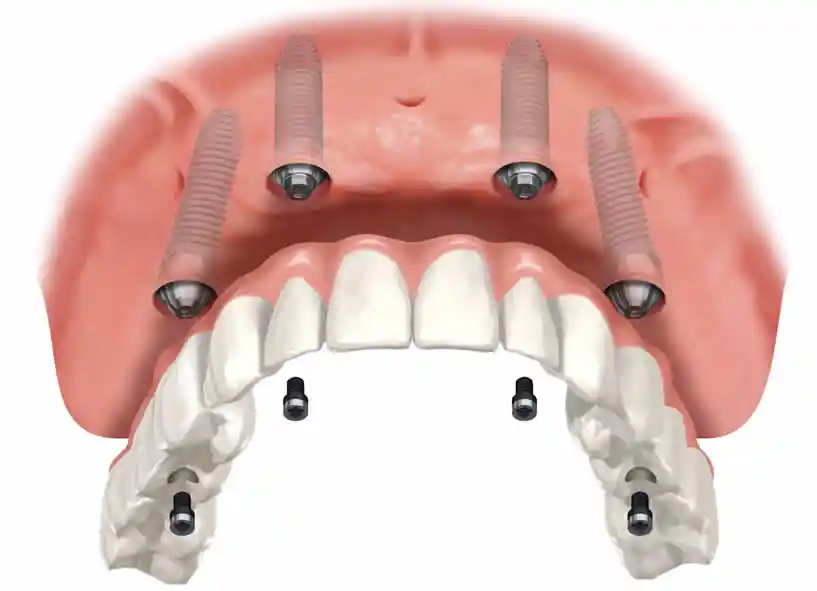
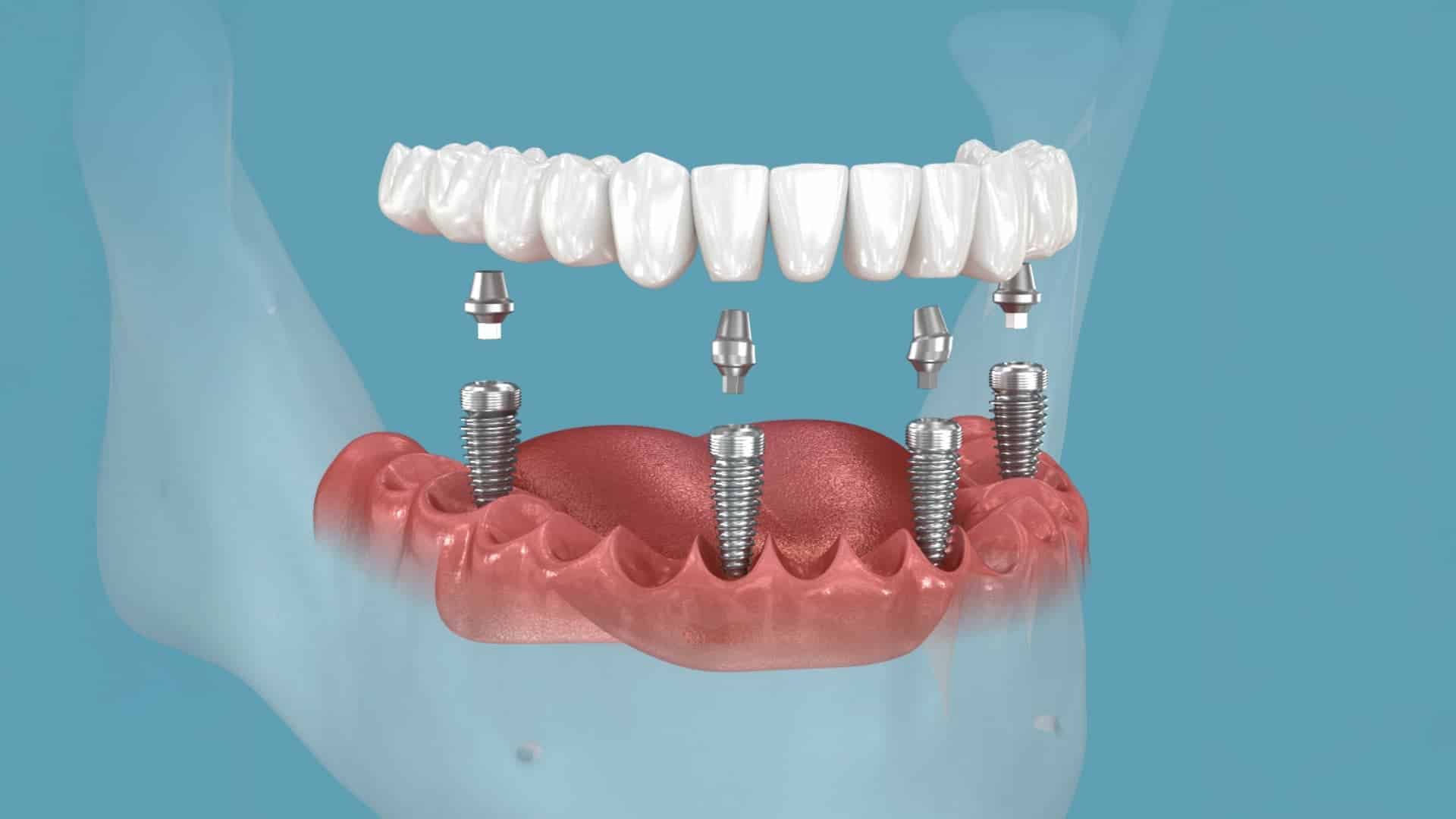
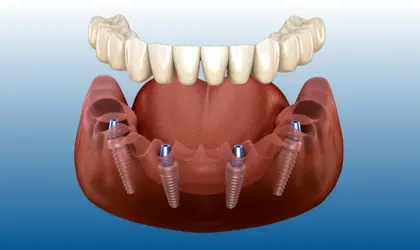
| Fully Edentulous Jaw (Fixed) | 4 – 8 | Full-Jaw Fixed Hybrid/Porcelain Prosthesis | All-on-4 / All-on-6 or conventional fixed systems |
What Are the Alternatives to an Implant for a Single Missing Tooth?
The main alternatives to implant treatment for a single missing tooth are conventional bridge prosthetics, adhesive (Maryland) bridges, and removable partial dentures. These alternatives are evaluated by the dentist based on the condition of the jawbone, the health of the neighboring teeth, and the individual’s general condition.
Different treatment methods have their own advantages and points that need attention relative to one another:
- Conventional Bridge Prosthesis: A method in which the neighboring teeth on both sides of the missing tooth gap are slightly reduced (prepared) and used as supporting abutments. It does not require a surgical procedure, but it does involve wearing down healthy tooth structure.
- Adhesive (Maryland) Bridge: Winged prosthetics attached to the chewing surfaces or back sides of neighboring teeth with special adhesive materials. It is generally preferred as a temporary or minimally invasive option for missing teeth in the front region, where chewing force is lower.
- Removable Partial Dentures: Appliances that draw support from the remaining teeth and tissues in the mouth and can be inserted and removed by the patient. Although generally used for multiple missing teeth, they can also be applied as a temporary prosthesis for a single tooth.
| Treatment Method | Effect on Neighboring Teeth | Surgical Intervention | Level of Bone Preservation |
|---|---|---|---|
| Single-Tooth Implant | Neighboring teeth are not touched | Requires a surgical procedure | Slows resorption by transmitting force to the bone |
| Conventional Bridge | Neighboring teeth are worn down | Does not require a surgical procedure | Bone beneath the gap may continue to resorb |
| Adhesive (Maryland) Bridge | Minimal reduction is done | Does not require a surgical procedure | Does not directly transmit biomechanical stimulation to the bone tissue |
| Removable Denture | May place pressure on teeth via clasps | Does not require a surgical procedure | Ridge resorption may occur depending on tissue support |
How Many Implants Are Needed in Cases of Complete Edentulism?
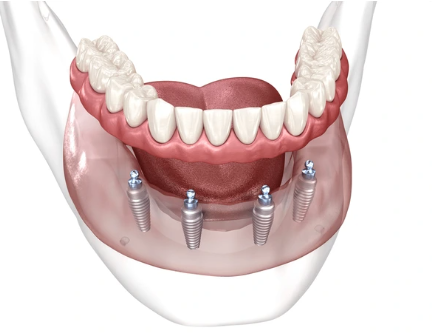
In cases of complete edentulism, placing 4 to 6 implants in the lower jaw and, depending on bone structure, 4 to 8 implants in the upper jaw is a common practice for making a fixed prosthesis possible. In overdenture systems with clip attachments, which are used to increase the retention of removable dentures, 2 to 4 implants in the lower jaw may be sufficient.
Because the bone density of the upper jaw has a spongy (cancellous) structure, it may require more implant support compared to the lower jaw. Since the lower jawbone has a more compact (dense) structure, stability can be achieved with fewer implants.
In clinics across Ankara where implant planning is carried out, in cases of complete edentulism the patient’s bone width, sinus distances, and mandibular canal position are examined using three-dimensional imaging methods. Based on this, a distinction is made between fixed and removable prostheses and the number of implants is determined accordingly.
Is There an Age Limit? Can Implants Be Placed in Young People and Elderly Individuals?
While the lower age limit for implant treatment is tied to the completion of bone development, there is no established upper age limit for individuals whose general health condition is suitable. Implants can be applied in adult individuals whose bone growth has been completed and in elderly patients whose systemic condition is under control.
Placing an implant in young individuals during the period when jaw bone growth and development are still ongoing is not recommended. Because an implant cannot move together with bone development the way natural teeth do, it remains fused with the bone (ankylosis) as a fixed structure, and level differences occur as neighboring teeth continue to elongate. For this reason, the procedure is performed only after it has been radiologically confirmed that bone development has been completed—on average around age 16-18 in girls and 18-20 in boys.
In elderly individuals, biological age and systemic condition take priority over chronological age. Implant treatment can be planned for elderly individuals whose chronic conditions—such as heart disease, blood pressure, and diabetes—are being monitored and kept under control by a physician.
Do Smoking and Tobacco Use Prevent Implant Placement?
While smoking is not an absolute barrier to implant treatment, it increases the risk of complications by reducing tissue oxygenation and weakening the mouth’s defense mechanisms. For this reason, individuals who use tobacco are advised to limit or quit its use both before and after surgery.
The chemical compounds found in tobacco smoke cause narrowing (vasoconstriction) in the capillaries of the gum tissues. This reduces the blood flow reaching the surgical site and delays the healing process. The incidence of infection around the implant (peri-implantitis) is higher among tobacco users compared to non-users.
Can an Implant Be Placed on the Same Day as a Tooth Extraction? (Immediate Implantation)
In cases where there is no acute or widespread infection around the tooth to be extracted, the bone walls of the extraction socket are intact, and sufficient primary stability can be achieved, an implant can be placed in the same session. This procedure is referred to in the literature as immediate implantation.
Immediate implantation combines the tooth extraction and implant placement procedures into a single surgical session, which can shorten the overall treatment time and somewhat limit the bone resorption that may occur after tooth extraction. However, if there is an extensive cystic or inflammatory lesion at the tip of the tooth root, the tooth is extracted first and the area is allowed 2 to 3 months to heal and form bone.
What Examinations and Assessments Are Performed Before Implant Treatment?
Before implant planning, a detailed intraoral examination, a panoramic X-ray, and, when deemed necessary, three-dimensional dental volumetric tomography (CBCT) scans are performed. These examinations are used to assess the millimetric thickness of the bone, the location of anatomical cavities, and the condition of the surrounding tissues.
At clinics providing oral and dental health services—such as, for example, Panorama Ankara in Ankara—the following stages are typically followed before treatment:
- Clinical Examination: Gum health, bite relationships (occlusion), mouth opening, and the condition of the chewing muscles are examined.
- Radiological Imaging: The vertical and horizontal dimensions of the jawbone, the sinus cavities, and the nerve canal passing through the lower jaw (inferior alveolar nerve) are measured three-dimensionally on tomography.
- General Health Assessment: The medications the patient is using, past surgeries, and systemic conditions are recorded in detail via a medical history form.
- Digital Impressions and Planning: The oral structure is scanned using digital scanners, and surgical guide (static guide) plans can be prepared.
What Should Be Paid Attention to During the Healing Process After Implant Treatment?
After an implant is placed, regularly taking the medications prescribed by the dentist, applying cold compresses in the first few days, eating soft foods, and carefully maintaining oral hygiene support the healing process. Hard foods and hot beverages that could cause trauma to the surgical site should be avoided in the first few days.
The main points to pay attention to during the post-operative tissue healing and bone fusion stages are as follows:
- Oral Hygiene: The treated area should not be touched directly with a toothbrush for the first 24 hours; antiseptic mouthwashes recommended by the dentist should be used instead. Brushing of the other teeth should continue as normal.
- Diet: During the 2- to 6-month period in which the implants fuse with the bone, excessive pressure on the implant site should be avoided until the prosthetic stage is reached.
- Routine Check-ups: Follow-up visits should be attended at the intervals set by the dentist for suture removal and to monitor tissue adaptation.
- Tobacco Restriction: Avoiding tobacco products during the healing period is recommended so that tissue nourishment is not disrupted.
Frequently Asked Questions
Can Diabetic Patients Get Implants?
If a diabetic patient’s blood sugar and HbA1c levels are under control, implant treatment can be planned. The dentist may communicate with the internal medicine specialist following the patient to obtain approval for treatment.
How Much Does Bone Graft Application Extend the Healing Time?
The waiting period required for new bone tissue to form and integrate with the implant in areas where a bone graft has been applied can vary, averaging between 3 and 6 months depending on the surgical method used.
Is the Approach to Implants Different for Front Teeth Versus Back Teeth?
In the front tooth region, aesthetic expectations and gum contour (“pink aesthetics”) are the priority, while in the back tooth regions, durable materials and bone support that can withstand high chewing forces take precedence.
Is There a Risk That the Implant Will Not Fuse with the Bone?
Although rare, an implant may fail to fuse with the bone due to systemic factors, inadequate oral care, tobacco use, or infections that develop at the surgical site. In such cases, the implant is removed from the site and the tissue is allowed to heal, after which re-planning can be carried out.